A restaurant’s electrical installation is far more complex than it appears. It is not simply a matter of placing sockets and lights: a restaurant concentrates considerable electrical power in a relatively small space, with high-consumption kitchen equipment, refrigeration systems running 24 hours a day, commercial lighting, HVAC, forced ventilation and safety systems. All of this must operate simultaneously, reliably and safely.
A flawed design leads to circuit breakers tripping during peak service, overheated cables, voltage drops affecting equipment performance and, in the worst case, fire risks. This guide walks you through the entire process, from power calculation to regulatory approval.
Step 1: Equipment inventory and power calculation
The first step is to compile an exhaustive list of every piece of electrical equipment the restaurant will use, together with its rated power. A medium-sized restaurant of 100-150 m2 can require between 60 and 120 kW of installed power.
Typical kitchen equipment
| Equipment | Typical power |
|---|---|
| Combi oven (convection/steam) | 12-20 kW |
| Industrial griddle | 6-10 kW |
| Electric fryer | 6-9 kW |
| Industrial dishwasher | 6-12 kW |
| Induction hob (4 zones) | 12-15 kW |
| Extraction hood with motor | 1-3 kW |
| Blast chiller | 2-4 kW |
Refrigeration equipment
| Equipment | Typical power |
|---|---|
| Positive cold room | 1-3 kW |
| Negative cold room | 2-5 kW |
| Bottle cooler | 0.3-0.8 kW |
| Refrigerated prep table | 0.5-1.5 kW |
| Ice machine | 0.5-1.5 kW |
Other loads
| Item | Typical power |
|---|---|
| HVAC (100 m2 dining area) | 10-18 kW |
| Total lighting | 3-6 kW |
| POS, coffee machine, toaster, etc. | 3-8 kW |
| Ventilation and extraction | 2-5 kW |
Diversity factor
Not all equipment runs at full power at the same time. The diversity factor (or simultaneity coefficient) calculates the real maximum power the installation must handle. For a restaurant, a factor between 0.6 and 0.8 is typical, depending on the type of cuisine and the number of services.
Example: if the total installed power is 90 kW and the diversity factor is 0.7, the maximum simultaneous power will be 63 kW. This is the reference for sizing the electrical supply.
Step 2: Type of electrical supply
Based on the power required:
- Single-phase (up to 15 kW): insufficient for most restaurants, except very small ones.
- Three-phase at 400 V: the standard supply for restaurants. It allows loads to be distributed across three phases and enables the use of higher-power three-phase equipment (ovens, HVAC).
The supply application to the distribution company should be submitted well in advance, as the service connection may require works or transformer reinforcement.
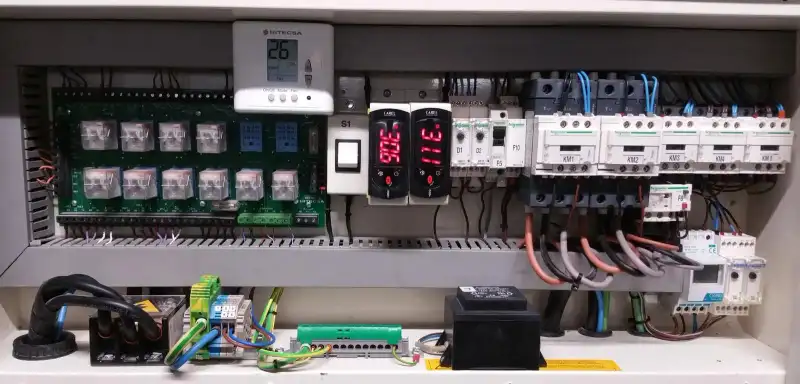
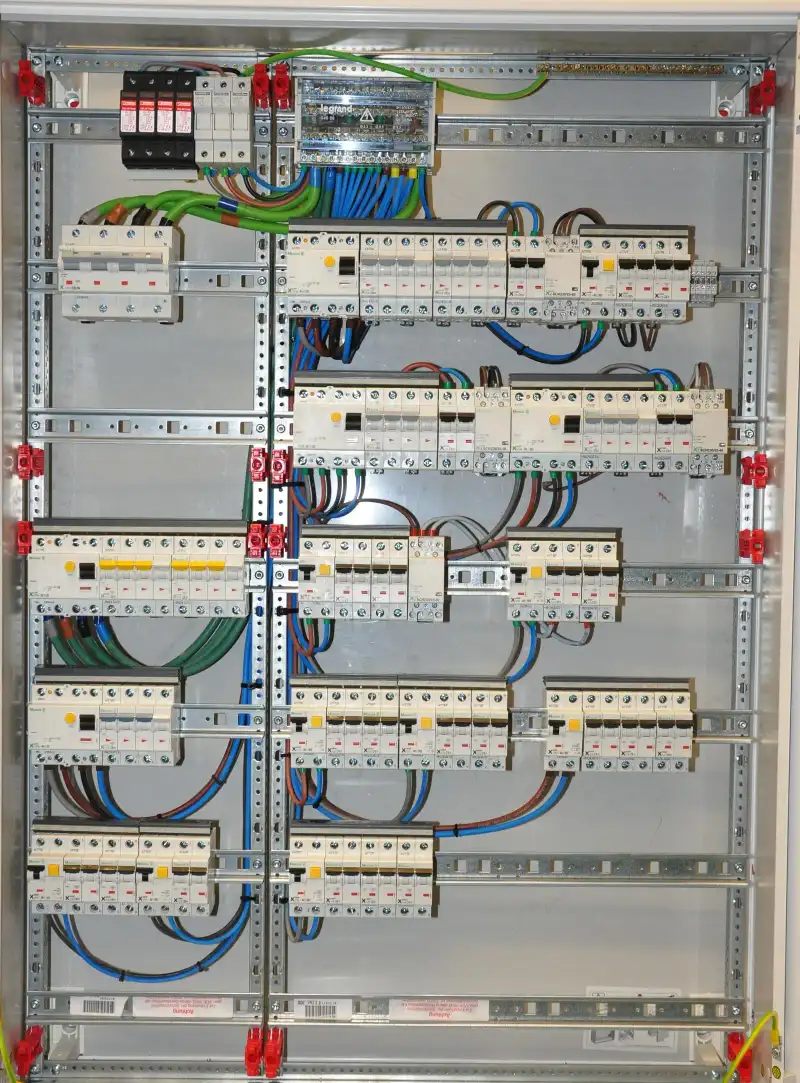
Step 3: Electrical panel design and circuits
The electrical panel is the nerve centre of the installation. The Low Voltage Electrical Regulations (REBT) and their complementary technical instructions (ITC-BT) set the design requirements.
Panel structure
A restaurant requires a main control and protection panel (CGMP) with, at minimum, the following elements:
- Main circuit breaker (IGA): all-pole disconnection with overload and short-circuit protection.
- Residual current devices (RCDs): protection against indirect contact. A separate RCD for each functional group (kitchen, dining area, refrigeration, HVAC) is recommended so that a single trip does not affect the entire installation.
- Individual MCBs: one per circuit, rated to match the cable cross-section and anticipated load.
Recommended circuits
| Circuit | Typical cable size | Protection |
|---|---|---|
| Combi oven | 6 mm2 (three-phase) | 32 A MCB + 30 mA RCD |
| Induction hob | 6 mm2 (three-phase) | 32 A MCB + 30 mA RCD |
| Fryer | 4 mm2 (single-phase) | 25 A MCB + 30 mA RCD |
| Dishwasher | 4-6 mm2 | 25-32 A MCB + 30 mA RCD |
| Cold rooms | 2.5 mm2 (each) | 16 A MCB + 30 mA RCD |
| Dining area lighting | 1.5 mm2 | 10 A MCB + 30 mA RCD |
| Kitchen lighting | 1.5 mm2 | 10 A MCB + 30 mA RCD |
| Dining area sockets | 2.5 mm2 | 16 A MCB + 30 mA RCD |
| Kitchen sockets | 4 mm2 | 20 A MCB + 30 mA RCD |
| HVAC | As per equipment | MCB as per load + 30 mA RCD |
| Extraction | 2.5 mm2 | 16 A MCB + 30 mA RCD |
| Emergency lighting | 1.5 mm2 | 10 A MCB + 30 mA RCD |
Each high-power item of equipment must have its own dedicated circuit. Kitchen equipment and refrigeration equipment must never share a circuit.
Step 4: Kitchen-specific requirements
A restaurant kitchen is an especially demanding environment for the electrical installation:
- Moisture protection: sockets and devices must have a minimum IP44 protection rating in areas exposed to splashing.
- Equipotential bonding: all metallic masses in the kitchen (stainless steel tables, extraction hoods, sinks) must be connected to the earthing network.
- Separation from gas supply: if the kitchen has gas equipment, the electrical installation must maintain the safety distances specified by the REBT from gas pipes and supply points.
- Kitchen lighting: a minimum of 500 lux in work zones, as required by workplace health and safety regulations.
Step 5: Dining area and facade lighting
Restaurant lighting is not just functional — it is part of the customer experience. From an electrical standpoint, provisions must include:
- Independent circuits per zone (bar, dining room, terrace, toilets) to allow independent control.
- Dimmer compatibility: if dimming will be used, circuits and luminaires must be compatible.
- Emergency lighting: mandatory in all public assembly premises. It must operate for at least 1 hour on battery backup and illuminate evacuation routes to a minimum of 1 lux.
- External illuminated signs: require a dedicated circuit and, in many cases, a municipal licence.
Step 6: Earthing installation
The earthing network is the fundamental protection against electrocution. In a restaurant, with a large number of metallic items of equipment in contact with water, its importance is critical.
- All metallic masses must be connected to earth.
- Earth resistance must be below 37 ohms (for installations with 30 mA RCDs).
- The protective conductor must reach every point of consumption.
- The earth rod or ring must be tested periodically.
Step 7: Electrical project and approval
A restaurant electrical installation requires, in most cases, a technical project signed by an engineer or authorised electrical installer, depending on the power:
- Power up to 100 kW: design technical report signed by an authorised electrical installer.
- Power above 100 kW: technical project signed by a qualified engineer.
Approval process
- Preparation of the project or technical report.
- Execution of the installation by an authorised installer.
- Issue of the electrical installation certificate by the installer.
- Submission of documentation to the Valencian Community’s regional industry department.
- Inspection by an Authorised Control Body (OCA) if the power exceeds 100 kW or the premises are classified as a public assembly venue.
- Application for final supply from the distribution company.
Common mistakes to avoid
- Underestimating power: failing to plan for future expansion forces a costly redesign when new equipment is added.
- Inaccessible electrical panel: the panel must be accessible at all times — never behind shelving or inside a storeroom.
- Not separating critical circuits: cold rooms must have completely independent circuits so that an RCD trip in the kitchen does not leave them without power.
- Forgetting kitchen ventilation: forced extraction is not merely a regulatory requirement; without it, heat and grease deteriorate the electrical installation.
At Acoval, we design and carry out electrical installations for restaurants and hospitality venues, from the power study through to full regulatory approval. If you are planning a new restaurant opening or a refurbishment, contact us and we will prepare a technical and financial proposal.