A poorly executed electrical installation in commercial premises does not merely cause operational problems (power cuts, tripping circuit breakers, equipment malfunctions) — it can cause fires, electrocution and serious administrative penalties. And the most frustrating part is that the majority of these problems are entirely preventable.
After years of designing and installing electrical systems in commercial premises of every type, these are the mistakes we encounter most frequently and the consequences they carry.
Mistake 1: Not calculating the required power correctly
This is the most common mistake and the one with the most lasting consequences. It occurs when the electrical supply power or installation sizing is underestimated, whether through lack of knowledge, an attempt to save on the installation or a failure to anticipate the business’s real needs.
Consequences:
- The main circuit breaker trips during peak hours.
- Not all equipment can be operated simultaneously.
- Cables operate above their rated capacity, generating heat and fire risk.
- A power upgrade must be requested from the distribution company, which may require a new service connection and transformer reinforcement, costing thousands of euros and taking weeks or months.
How to avoid it:
- Compile a thorough inventory of all planned electrical equipment with their rated power.
- Apply a realistic diversity factor (do not confuse installed power with simultaneous power).
- Allow a 20-30% margin for future expansion.
- Request the necessary power from the outset, since reducing it later is straightforward but increasing it can be costly and slow.
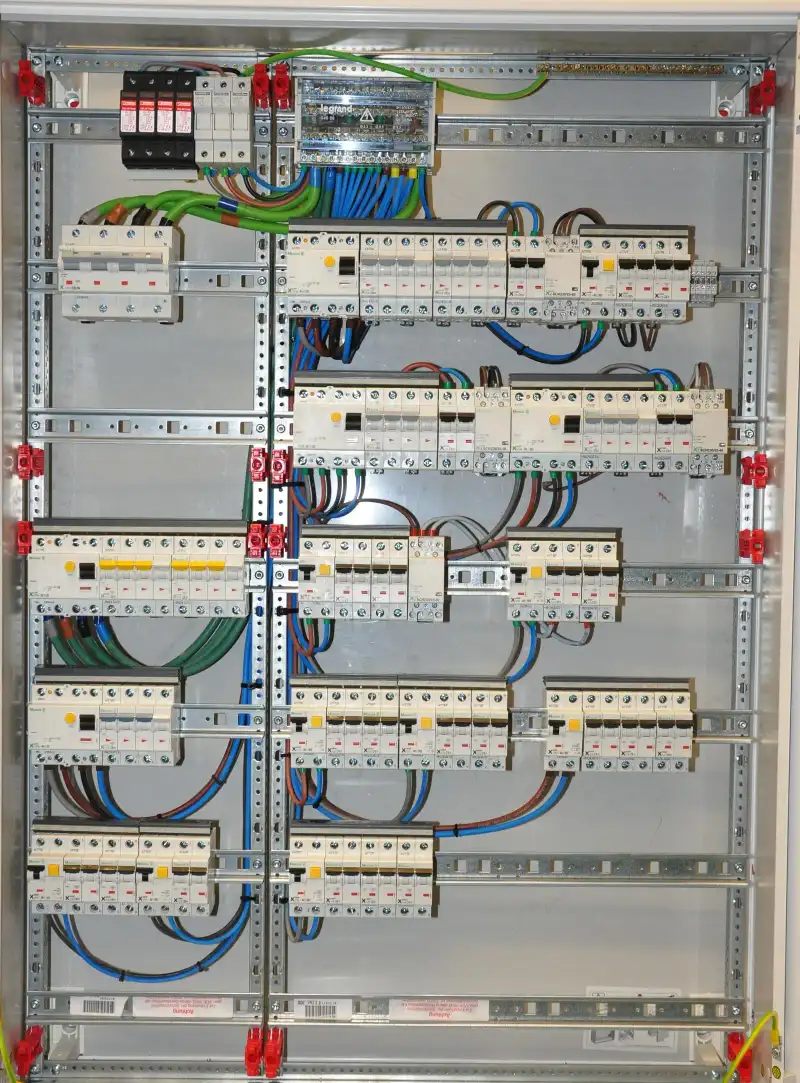
Mistake 2: A single RCD for the entire installation
The residual current device (RCD) detects leakage current and disconnects the installation to prevent electrocution. In many premises, the entire installation depends on a single RCD. When it trips, everything goes dark: cash register, cold rooms, lighting, HVAC.
Consequences:
- A fault in one piece of equipment cuts power to the entire premises.
- Cold rooms lose temperature during the outage, risking food safety.
- The cash register shuts down, interrupting sales.
- If the RCD trips overnight due to a minor defect (e.g. in the window display lighting), the cold rooms spend the entire night without refrigeration.
How to avoid it:
- Install separate RCDs for each functional group: lighting, general sockets, kitchen/bakery, cold rooms, HVAC.
- Use selective or time-delayed RCDs at the main panel to prevent a downstream trip from affecting the rest of the installation.
- Cold rooms must always have a circuit with an independent RCD.
Mistake 3: Deficient or missing earthing
The earthing system is the fundamental protection against electrocution. In commercial premises with metallic casings, equipment connected to water (dishwashers, ice machines), wet surfaces and public access, its importance is critical.
Consequences:
- Real risk of electrocution for staff and customers.
- RCDs cannot function correctly without adequate earthing.
- In the event of an accident, civil and criminal liability falls on the premises owner.
How to avoid it:
- Verify that earth resistance is below 37 ohms (for installations with 30 mA RCDs).
- Ensure all metallic masses (metal shelving, stainless steel tables, hoods, machinery) are connected to the protective conductor.
- Measure earth resistance periodically, as it can degrade over time.
Mistake 4: Undersized cable cross-sections
Using cables with a cross-section smaller than the circuit load demands is a mistake that can go unnoticed for months or years until it causes overheating, insulation failure or a fire.
Consequences:
- Excessive cable heating that can melt the insulation.
- Voltage drop reducing the performance of connected equipment.
- Fire risk, especially if cables run through suspended ceilings or trunking with combustible materials.
How to avoid it:
- Size each circuit’s cross-section according to the cable’s maximum admissible current, the circuit length (to verify voltage drop) and the type of containment (embedded, on tray, in conduit).
- Do not reuse cabling from a previous installation without verifying it meets the requirements of the new one.
- Always comply with the minimum cross-sections specified by the REBT for each circuit type.
Mistake 5: Not separating critical circuits from general circuits
Connecting cold rooms, security alarms or emergency lighting on the same circuit as general sockets is a practice that creates serious problems.
Consequences:
- A short circuit in an appliance can cut power to the cold rooms.
- An employee plugging in a faulty tool can disable the premises alarm.
- Emergency lighting fails to work when needed most because it shares a circuit with equipment that caused the trip.
How to avoid it:
- Provide independent, clearly labelled circuits for:
- Cold rooms.
- Alarm and security systems.
- Emergency lighting.
- HVAC.
- High-power equipment (ovens, dishwashers, griddles).
Mistake 6: Inaccessible or poorly located electrical panel
The electrical panel is the point from which the entire installation is controlled and protected. It must be accessible at all times to enable action in an emergency, carry out checks or disconnect circuits during maintenance.
Common errors:
- Panel installed behind merchandise shelving.
- Panel located inside a cold room (yes, it happens).
- Panel recessed into a wall and covered by a mirror or artwork.
- Panel at a height requiring a ladder to reach.
Basic requirements:
- Height between 1.4 and 2 metres from the floor.
- Clear, unobstructed access.
- Marked with the electrical hazard symbol.
- All circuits correctly labelled in the panel.
Mistake 7: Not obtaining regulatory approval for the installation
A worrying proportion of commercial premises operate with an electrical installation that is either unapproved or approved with documentation that does not reflect the actual installation. This can happen because modifications were made after approval, because the work was carried out by unauthorised personnel or simply because the certificate was never processed.
Consequences:
- In the event of an accident or fire, the insurance company may refuse to pay out if the installation is unapproved.
- All civil and criminal liability falls on the owner.
- An Authorised Control Body (OCA) inspection can result in the supply being suspended until deficiencies are rectified.
- Inability to obtain or renew activity licences.
How to avoid it:
- Always request the electrical installation certificate from the installing company.
- Verify that the installing company is qualified and registered with the regional authority.
- If subsequent modifications are made, update them in a new certificate.
Mistake 8: Ignoring public assembly venue regulations
Commercial premises open to the public have additional electrical requirements compared with a home or industrial unit. ITC-BT-28 of the REBT sets specific conditions for public assembly venues:
- Emergency lighting mandatory with a minimum 1-hour battery autonomy.
- Secondary power source (generator or UPS) in venues with a capacity exceeding 300 people or with high-risk activities.
- Security circuits separated from the rest of the installation.
- Enhanced protection against direct and indirect contact.
Non-compliance with these requirements is not merely an administrative offence: in an emergency (fire, evacuation), the lack of emergency lighting can have devastating consequences.
Mistake 9: Reusing a previous tenant’s installation without verification
When premises change activity (e.g. from a clothing shop to a restaurant), the previous tenant’s electrical installation is almost never suitable for the new use. Yet many entrepreneurs assume that “if it worked before, it will keep working” and commission neither a survey nor an adaptation.
Consequences:
- Insufficient power for the new equipment.
- Inadequate cable cross-sections for the new loads.
- Incorrect protection settings.
- Outdated documentation.
How to avoid it:
- Always commission a full survey of the installation before starting a new activity in existing premises.
- Obtain a new installation certificate reflecting the actual use of the premises.
The electrical installation as the foundation of the business
A properly executed electrical installation is invisible: it works, it is safe, it causes no problems and it complies with regulations. A poorly executed one makes itself visible in the worst possible way: outages, breakdowns, penalties or, in the worst case, an accident.
At Acoval, we design and carry out electrical installations for commercial premises of every type: shops, restaurants, supermarkets, offices and warehouses. We handle the project, execution, regulatory approval and maintenance.
If you are preparing to open new premises or suspect your current installation may have any of these problems, contact us and we will carry out a technical inspection to verify the condition of your installation.