The electrical installation of an industrial warehouse is one of the most demanding projects a business can undertake. It is not simply a matter of running power to the machines: you need to ensure safety, comply with regulations, anticipate future growth and minimise long-term energy costs.
This guide covers everything you need to know before embarking on the electrical installation of an industrial warehouse, from initial planning to emergency systems, including compliance with the REBT (Reglamento Electrotecnico de Baja Tension — Spain’s Low Voltage Electrical Regulation).
Initial planning: the foundation of everything
A well-resolved electrical project begins long before the first trench is dug. The planning phase must answer these questions:
- What total power is needed? Add up the ratings of all expected loads (machinery, lighting, HVAC, offices) applying realistic simultaneity factors.
- What is the growth forecast? A warehouse running one shift today may be running three shifts in five years. Sizing with headroom avoids costly expansions.
- What type of supply connection is needed? Depending on the power requirement, a low-voltage connection may suffice or an on-site transformer substation may be necessary.
- Are there special loads? Furnaces, presses, welding machines, large compressors or electric vehicle chargers have specific requirements that must be considered from the outset.
A certified technical project is mandatory for industrial installations, and it is also the best guarantee that the final result will be safe and legally compliant.
REBT compliance in industrial installations
The REBT, approved by Royal Decree 842/2002, is the reference standard for all low-voltage installations in Spain. For industrial warehouses, the most relevant supplementary technical instructions (ITCs) are:
- ITC-BT-04: documentation and commissioning of installations.
- ITC-BT-19: general requirements for internal installations, including minimum conductor cross-sections and permissible voltage drops (maximum 3% for lighting and 5% for motor circuits).
- ITC-BT-22 and 23: protection against overcurrents and overvoltages.
- ITC-BT-24: protection against direct and indirect contact.
- ITC-BT-47: motor installations, with particular attention to starting methods and protections.
Before commissioning, the installation must pass an initial inspection by an Authorised Inspection Body (OCA). Installations above 100 kW are also subject to periodic inspections every five years.
Electrical panels: the heart of the installation
The main distribution board (CGMP in Spanish) is the central element of any industrial installation. The safety of the entire installation and the ease of maintenance over the years depend on its quality and design.
Main panel
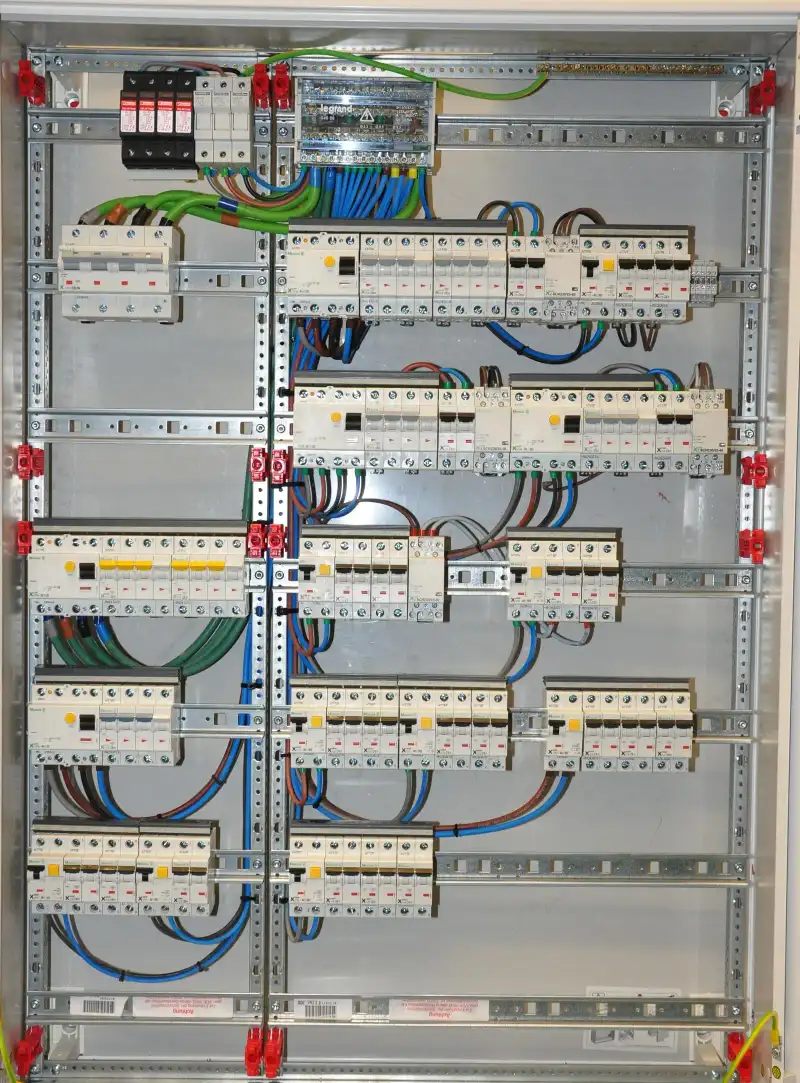
Houses the main protections: general isolator switch, high-sensitivity residual current device (RCD) and the circuit breakers for each branch circuit. It must be correctly sized, ventilated and labelled.
Zone sub-panels
In larger warehouses, it is common to distribute the load via sub-panels located close to the consumption centres. This reduces cable cross-sections, makes fault-finding easier and improves protection selectivity.
Automation and control panels
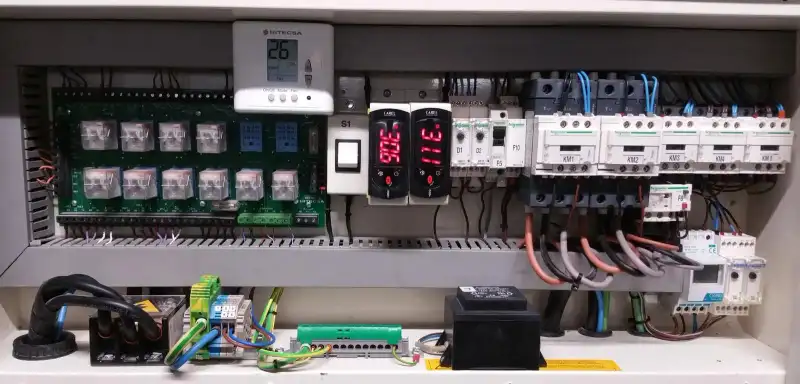
If the warehouse has automated production lines, PLCs, variable frequency drives and SCADA systems require stabilised power supplies and specific overvoltage protections.
At Acoval we manufacture industrial electrical panels in our own workshop, which allows us to control the quality of every component and guarantee compliance with the IEC 61439 standard.
Power distribution and cabling routes
The distribution of energy from the main panel to consumption points is another critical aspect. The main options are:
- Ladder or perforated cable tray: ideal for main runs with many cables. Allows easy inspection and accommodates future additions.
- Rigid or flexible conduit: suitable for branch connections to machines and areas with mechanical risk.
- Floor trunking: in transit areas where cables cannot be elevated.
- Busbars: in high-power installations where feeding multiple machines along a line is common.
Cable runs must respect minimum bending radii and avoid proximity to water, gas or steam pipes that could generate condensation or affect conductor temperature.
Industrial lighting: efficiency and safety
Warehouse lighting has a direct impact on productivity, worker safety and energy consumption. The basic criteria are:
- Illuminance level: between 200 and 500 lux in work areas, depending on the task type, in accordance with Royal Decree 486/1997.
- LED technology: currently the dominant option due to its efficiency (up to 160 lm/W), long service life (>50,000 hours) and reduced maintenance.
- Uniformity: avoid areas with strong contrasts that cause visual fatigue or make it difficult to spot hazards.
- Control and dimming: DALI or 0-10 V systems allow light levels to be adapted to conditions at any given moment, reducing consumption by up to 40%.
In the Valencian Community, many warehouse owners have upgraded their lighting with support from IVACE grants, achieving payback periods of two to four years.
Emergency systems and fire protection
Emergency lighting is mandatory in industrial warehouses under Spain’s Building Code (CTE) and the REBT (ITC-BT-28). It must activate automatically upon failure of the main supply and maintain a minimum level of 1 lux on evacuation routes.
In addition to emergency lighting, the following are typically integrated into the electrical project:
- Fire detection systems: with their own power supply circuit and battery backup.
- Power supply for fire doors and smoke dampers: via independent circuits with fire-resistant cable (CR1-C1 type or equivalent).
- Power sockets for firefighting equipment: accessible and clearly signposted.
Energy efficiency: beyond the basic installation
A modern electrical installation in an industrial warehouse cannot ignore energy efficiency. The most common measures include:
- Reactive power compensation: automatic capacitor banks that keep the power factor above 0.95, avoiding surcharges on the electricity bill.
- Variable frequency drives on pump, fan and compressor motors, which can cut consumption by up to 50% under variable loads.
- Consumption monitoring: remote management systems that identify abnormal consumption and optimise equipment operation.
- Photovoltaic integration: the roof of an industrial warehouse is a high-value energy resource. A well-sized self-consumption installation can cover between 30% and 60% of electrical demand.
If your business is in Valencia or the Aldaia industrial area and you are planning the electrical installation of a warehouse, we recommend visiting our electricity services page to see how we can help you from design through to legalisation.
Conclusion: investing well from the start
A well-designed and executed industrial electrical installation is an investment that pays dividends for decades. Errors in planning or the use of low-quality materials generate problems that end up costing far more than the initial saving.
At Acoval we have been designing, executing and legalising industrial electrical installations in Valencia and across the Valencian Community for years. If you have a project in mind or need to bring an existing installation into REBT compliance, contact us and our technical team will prepare a tailored, no-obligation proposal.