Heating an industrial warehouse is a necessity that directly affects productivity, worker comfort and compliance with workplace health and safety regulations. But not all solutions are equal, and the difference in operating costs between a well-chosen system and an unsuitable one can amount to tens of thousands of euros per year.
This article provides an in-depth comparison of the three most relevant technologies for industrial warehouse heating: gas boilers with unit heaters, heat pumps (aerothermal) and infrared radiant panels. The aim is to provide sufficient technical and financial data for each business to assess which is the best option for its specific situation.
The three technologies in context
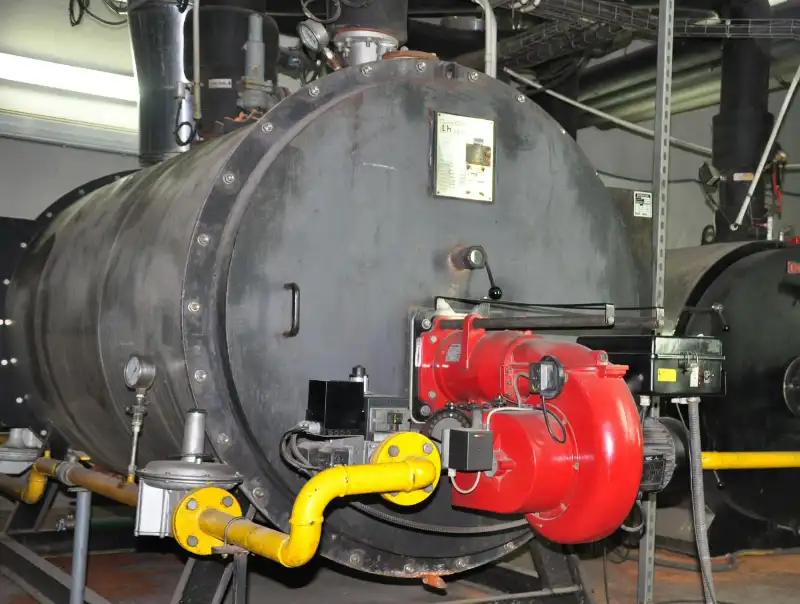
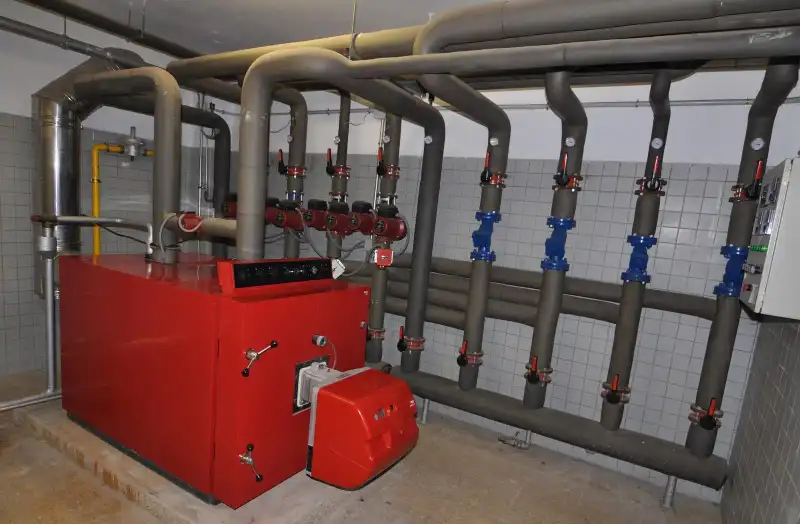
Gas boiler + unit heaters
The classic and still most common solution in industrial warehouses. A natural gas boiler (preferably condensing) heats water to 60-80 C, which is distributed via a hydraulic circuit to unit heaters (fan-assisted heat exchangers) positioned around the warehouse. The unit heaters blow warm air into the space.
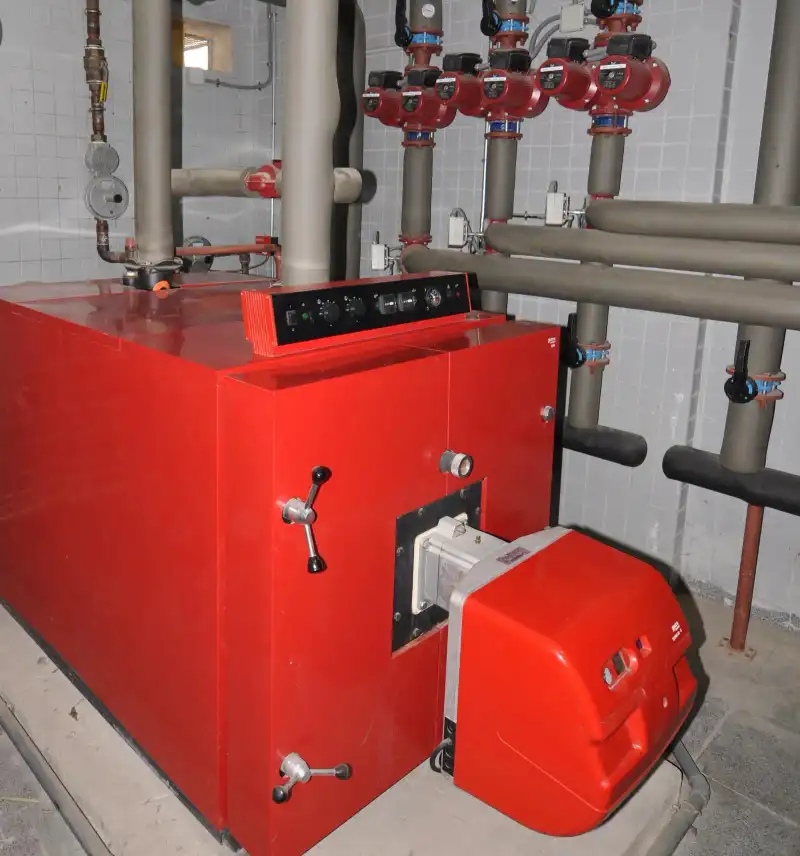
Aerothermal heat pump
The heat pump extracts thermal energy from outdoor air and transfers it to the warehouse interior. For each kWh of electricity consumed, it generates between 2.5 and 4.5 kWh of heat (depending on outdoor temperature). Heat can be distributed via unit heaters, fan coils, underfloor heating or ducted systems.
Infrared gas radiant panels
Radiant panels emit heat through direct infrared radiation, warming surfaces and people without heating the air. They are installed on the warehouse ceiling and fuelled by natural gas or propane. Two main types exist: luminous tube (high temperature) and dark tube (medium temperature).
Detailed technical comparison
| Criterion | Gas boiler + unit heaters | Heat pump (aerothermal) | IR radiant panels |
|---|---|---|---|
| Heating principle | Convection (warm air) | Convection or radiation (depending on emitter) | Infrared radiation |
| Rated efficiency | 95-109% (condensing) | COP 2.5-4.5 (250-450%) | 92-95% |
| Thermal stratification | High (heat rises) | Medium-high (with unit heaters) | Very low (heats the floor) |
| Response speed | Medium (15-30 min) | Medium (15-30 min) | Fast (5-10 min) |
| Direct CO2 emissions | Yes | No | Yes |
| Indoor noise | Medium (fans) | Low-medium | Very low |
| Maintenance | Medium | Low | Low |
| Typical lifespan | 15-20 years (boiler) | 15-20 years | 20-25 years |
| Requires flue/exhaust | Yes | No | Yes (ventilation) |
Financial analysis: investment and operating cost
The following figures correspond to a typical 1,000 m2 industrial warehouse, 7 metres high, with medium insulation (sandwich panel roof, block walls), located in the Valencian Community, with an estimated thermal demand of 120,000 kWh per year.
Estimated initial investment
| System | Estimated total investment |
|---|---|
| Condensing boiler + unit heaters | 18,000 - 25,000 euros |
| Heat pump + unit heaters | 30,000 - 45,000 euros |
| IR gas radiant panels | 20,000 - 30,000 euros |
The heat pump has the highest upfront cost, but this can be significantly reduced through available grants (Next Generation EU, IVACE), which in some programmes cover up to 40-50% of the cost.
Estimated annual operating cost
| System | Energy consumption | Unit price reference | Estimated annual cost |
|---|---|---|---|
| Gas boiler (condensing, 105% eff.) | 114,000 kWh gas | 0.055 euros/kWh | 6,270 euros |
| Heat pump (average COP 3.2) | 37,500 kWh elec. | 0.14 euros/kWh | 5,250 euros |
| Radiant panels (93% eff.) | 129,000 kWh gas | 0.055 euros/kWh | 7,095 euros |
Important note on radiant panels: although their cost per kWh of gas consumed is slightly higher than the boiler’s, in practice the total energy needed is significantly lower in high-ceiling warehouses. Since they heat surfaces directly rather than air, energy is not wasted on stratification. In warehouses over 7 metres high, radiant panels can require 30% to 50% less total energy than a convective system to achieve the same comfort in the working zone.
Adjusted figures for high-ceiling warehouses (>7 m):
| System | Adjusted annual cost (7 m warehouse) |
|---|---|
| Gas boiler + unit heaters | 6,270 euros (+ 20% for stratification = 7,524 euros) |
| Heat pump + unit heaters | 5,250 euros (+ 20% for stratification = 6,300 euros) |
| IR radiant panels | 5,000 - 5,500 euros (no stratification penalty) |
Return on investment (ROI)
ROI is calculated by comparing each system against the lowest-investment option (gas boiler) as the baseline:
| Comparison | Additional cost | Annual saving | Payback on additional cost |
|---|---|---|---|
| Heat pump vs gas boiler | 12,000 - 20,000 euros | 1,200 - 2,000 euros/year | 7-12 years |
| Heat pump vs boiler (with 40% grant) | 4,000 - 8,000 euros | 1,200 - 2,000 euros/year | 3-5 years |
| Radiant panels vs boiler (warehouse >7 m) | 2,000 - 5,000 euros | 1,500 - 2,500 euros/year | 1-3 years |
When to choose each system
Choose a gas boiler + unit heaters if:
- The warehouse is less than 5-6 metres high.
- A hydronic installation in good condition already exists and can be reused.
- Natural gas is available at a competitive tariff.
- Large-scale DHW production is also needed.
- The investment budget is limited and grants are not available.
Choose a heat pump (aerothermal) if:
- The lowest possible operating cost is the priority.
- The climate is mild (as in Valencia, where COP is high for most of winter).
- The business has or plans a photovoltaic self-consumption installation.
- Zero direct CO2 emissions are valued.
- Grants are available to reduce the upfront investment.
- Cooling is also needed in summer (a reversible heat pump covers both functions).
Choose infrared radiant panels if:
- The warehouse has a high ceiling (above 6-7 metres).
- Loading dock doors open and close frequently (logistics, dispatch).
- Fast heat is needed in specific zones without warming the entire warehouse.
- The warehouse has poor insulation, making it impractical to heat the full air volume.
- Occupancy levels vary greatly between zones.
Hybrid solution: the best of both worlds
Combining two technologies is increasingly common to optimise outcomes:
- Heat pump + gas boiler as backup: the heat pump covers the base load with its high efficiency, while the boiler only operates during the most intense cold spells when the heat pump’s COP drops.
- Radiant panels in the production area + heat pump in offices: each zone receives the system best suited to its use.
- Aerothermal + underfloor heating in new-build warehouses: the low water temperature of underfloor heating maximises the heat pump’s COP, achieving efficiencies of 4 to 5.
The regulatory factor
European and Spanish regulations increasingly favour electrification and renewable sources. Gas boilers will remain a legal option for years to come, but grants, tax deductions and energy tariff trends strengthen the position of the heat pump in the medium and long term.
The EU Ecodesign Regulation also imposes increasingly stringent minimum efficiency requirements for heat generators, which will force the least efficient boilers off the market.
The right decision starts with data
Choosing a heating system without a prior technical study risks getting it right by luck or getting it wrong with financial consequences for many years. A heat load calculation, an analysis of real warehouse conditions and an economic simulation with current tariff data allow the decision to be made on an informed basis.
At Acoval, we design and install industrial heating systems in Valencia and the Valencian Community. If you need to compare options for your warehouse with real data, contact us and we will prepare a no-obligation technical and economic study.