Heating an industrial warehouse has nothing in common with warming an office or a home. Volumes are enormous, ceiling heights often exceed six or seven metres, loading doors open and close constantly, and temperature requirements vary dramatically depending on the activity. A mechanical workshop with workers on their feet does not need the same temperature as a packing area where people sit for hours.
Choosing the wrong system means years of unnecessarily high energy bills, inadequate comfort for workers and, in many cases, the inability to meet occupational health and safety regulations on workplace environmental conditions (in Spain, Royal Decree 486/1997 sets minimum temperatures of 17 degrees C for light work and 14 degrees C for heavy physical work in enclosed workplaces).
This article compares the available options using technical and practical criteria to help you make the right decision.
Factors that determine the choice
Before discussing systems, it is essential to define the conditions of the problem:
- Floor area and volume: a 500 m2 warehouse with a 4-metre ceiling has a very different volume from one of the same area with a 10-metre ceiling. Volume determines the heating load.
- Insulation level: the thermal envelope (roof, walls, floor slab, glazing) dictates heat losses. A warehouse with an uninsulated metal-sheet roof loses far more heat than one with insulated sandwich panels.
- Activity and occupancy: the type of work determines the target temperature. Occupational regulations set minimum thresholds that must be met.
- Door opening frequency: logistics and loading/unloading facilities suffer enormous heat losses through doors. The system must be capable of recovering temperature quickly.
- Available energy sources: natural gas, electricity, biomass or diesel. Electricity tariffs and access to natural gas directly affect the operating cost of each option.
- Capital budget and time horizon: some systems have a higher installation cost but lower operating cost, and vice versa.
Industrial heating options
Hot-water unit heaters
Unit heaters are fan-assisted heat exchangers that receive hot water from a central boiler and distribute it throughout the warehouse as warm air. This is a well-established solution with the following characteristics:
- Advantages: moderate installation cost, fast ambient warm-up, good distribution when strategically positioned.
- Drawbacks: they create air draughts, heat accumulates at the top of the building (stratification), and performance drops significantly in tall warehouses. In an 8-metre building, the temperature difference between floor and ceiling can be 10-15 degrees C, which means energy is being spent heating a volume of air that does not benefit the workers below.
- Best suited for: warehouses of moderate height (up to 5-6 metres), workshops and production areas with physical activity.
Gas-fired infrared radiant panels
Radiant panels emit heat via infrared radiation, directly warming surfaces and people rather than the air. This principle is fundamentally different from convective systems (unit heaters) and has very important practical implications:
- Advantages: they eliminate thermal stratification, perform well in tall buildings, generate no draughts, start up quickly and consume 30% to 50% less energy than convective systems in high-ceilinged spaces.
- Drawbacks: they require a natural gas (or propane) supply, need a minimum installation height (generally 4 metres), and combustion product ventilation must comply with applicable regulations.
- Best suited for: tall warehouses, production areas with frequently opening doors, partly occupied storage facilities.
Electric infrared radiant panels
These work on the same principle as gas-fired panels but use electrical resistance elements as the heat source. They are simpler to install (no gas supply line or combustion ventilation needed) but have a higher operating cost unless electricity tariffs are competitive. They are a worthwhile option for small areas, localised heating or warehouses with a solar photovoltaic self-consumption installation.
Industrial underfloor heating
Hydronic underfloor heating embedded in the warehouse floor slab distributes heat evenly from floor level, eliminating stratification and providing superior comfort to any other system:
- Advantages: maximum temperature uniformity, no draughts, no stratification, compatible with low-temperature heat sources (heat pump, condensing boiler), and the thermal inertia of the floor slab acts as a heat store.
- Drawbacks: can only be installed in new-build warehouses or during full floor-slab refurbishments, has high thermal inertia (takes hours to reach design temperature), and is not suitable where rapid temperature changes are needed.
- Best suited for: new-build facilities with continuous use (shift production), large-format retail premises, areas where comfort is a priority.
Air-to-water heat pump (aerothermal)
A heat pump extracts heat from outdoor air and transfers it to the indoor heating circuit (unit heaters, underfloor heating or fan coils), with a coefficient of performance (COP) of 2.5 to 4.5 depending on conditions. This means that for every 1 kWh of electricity consumed, it generates between 2.5 and 4.5 kWh of thermal energy.
- Advantages: operating cost is significantly lower than gas or diesel boilers, no direct emissions, can also provide cooling in summer, and is compatible with solar photovoltaic self-consumption installations.
- Drawbacks: higher initial investment than a conventional boiler, COP decreases at very low outdoor temperatures (though in Valencia’s Mediterranean climate this is rarely an issue), and outdoor space is needed for the units.
- Best suited for: any type of industrial warehouse in a Mediterranean climate, especially if a solar photovoltaic installation is already in place or planned.
Natural gas or diesel boilers
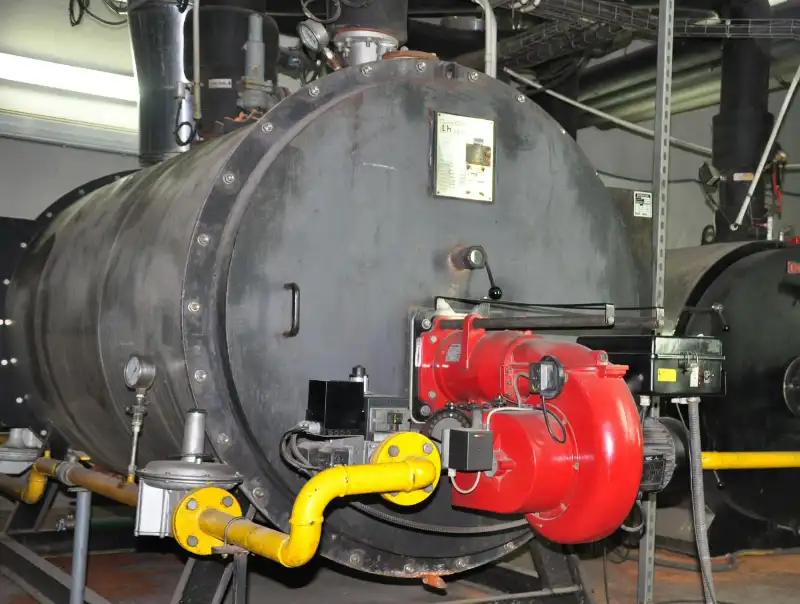
Natural gas condensing boilers remain a valid option for industrial installations, with efficiencies of 95-109% (based on LCV). However, their strategic position has shifted:
- Natural gas prices have experienced significant volatility, and the regulatory trend favours electrification.
- Diesel boilers are being phased out in favour of cleaner alternatives and face growing restrictions.
- A hybrid approach — heat pump as the primary system with a gas boiler for peak demand — is an increasingly common solution.
Decision criteria: a practical guide
| Factor | Unit heater | Gas radiant | Underfloor | Heat pump |
|---|---|---|---|---|
| Tall building | Fair | Excellent | Excellent | Depends on emitter |
| Installation cost | Low | Medium | High | Medium-high |
| Operating cost | Medium | Low | Low | Very low |
| Response speed | High | High | Low | Medium |
| Comfort | Medium | High | Very high | High |
| Frequent door openings | Poor | Good | Poor | Depends on emitter |
General recommendation for warehouses in Valencia
Valencia’s Mediterranean climate, with mild winters (minimum temperatures rarely dropping below 2-3 degrees C), particularly favours heat-pump-based solutions, whose performance is optimal in this outdoor temperature range. For tall warehouses, combining a heat pump with radiant panels or underfloor heating (in new builds) offers the best balance of investment, operating cost and comfort.
At Acoval Technical Installations we design and install industrial heating systems tailored to the needs of each warehouse and each activity in Valencia and the Valencian Community. We analyse the actual building conditions, the activity and usage patterns to recommend the most efficient solution. If you would like a personalised study for your warehouse, get in touch through our contact page.