Natural gas has been the default choice for heating and domestic hot water (DHW) in businesses, hotels, schools, care homes and industrial buildings for decades. However, volatile gas prices, decarbonisation targets and the continuous improvement of heat pump technology have radically changed the landscape. Today, for many businesses, aerothermal energy is the most cost-effective option from year one.
In this article we explain how aerothermal systems work, how much you can save, what financial support is available and when making the switch makes sense.
What is aerothermal energy and how does it work?
Aerothermal energy is a technology that extracts heat from outdoor air to provide heating, cooling and domestic hot water. It is based on the thermodynamic principle of the heat pump: just as a refrigerator extracts heat from its interior and expels it outside, an air-source heat pump extracts heat from outdoor air and transfers it to the building’s heating circuit or DHW storage tank.
The process works as follows:
- A fan draws outdoor air across an evaporator containing refrigerant at low temperature.
- The refrigerant absorbs heat from the air and evaporates.
- A compressor raises the pressure and temperature of the refrigerant gas.
- In the condenser, the heat is transferred to the building’s water circuit.
- The refrigerant expands and returns to its initial state, completing the cycle.
This process can produce heat even when outdoor temperatures reach -15 C to -20 C, although efficiency decreases as the temperature drops.
COP: the key to understanding the savings
The fundamental metric for understanding aerothermal savings is the COP (Coefficient of Performance). It expresses how many kWh of heat the pump produces for every kWh of electricity consumed.
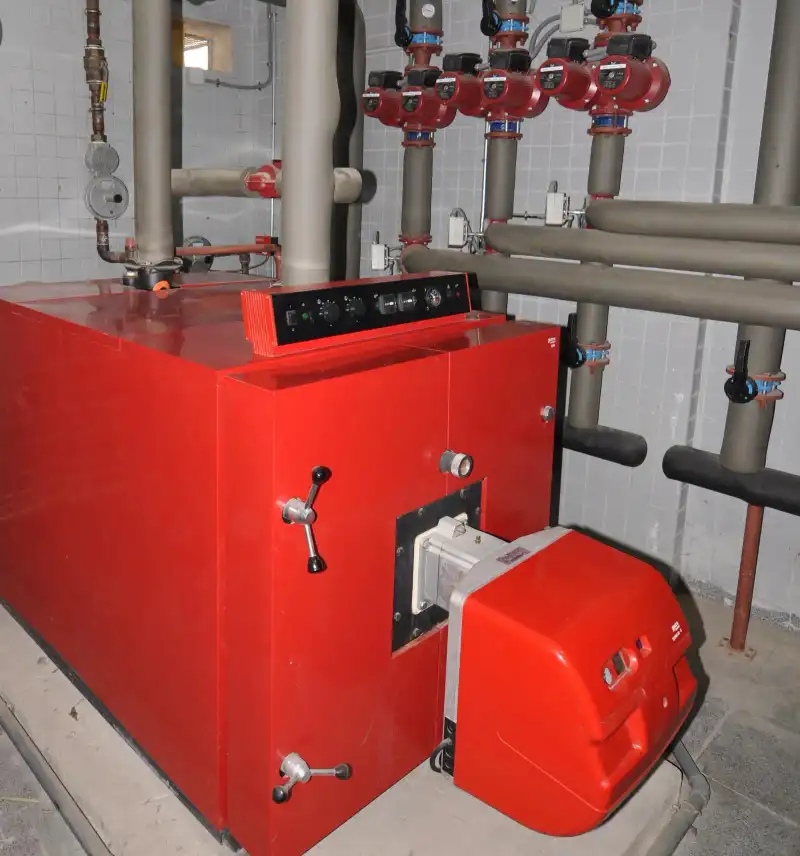
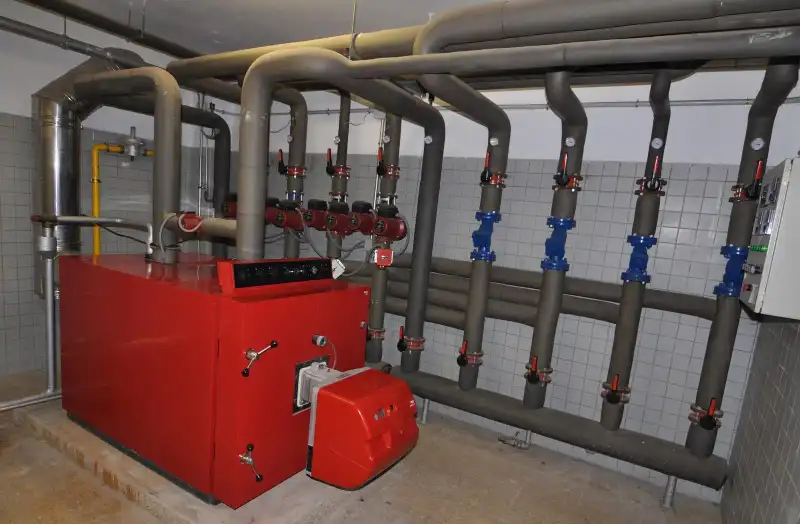
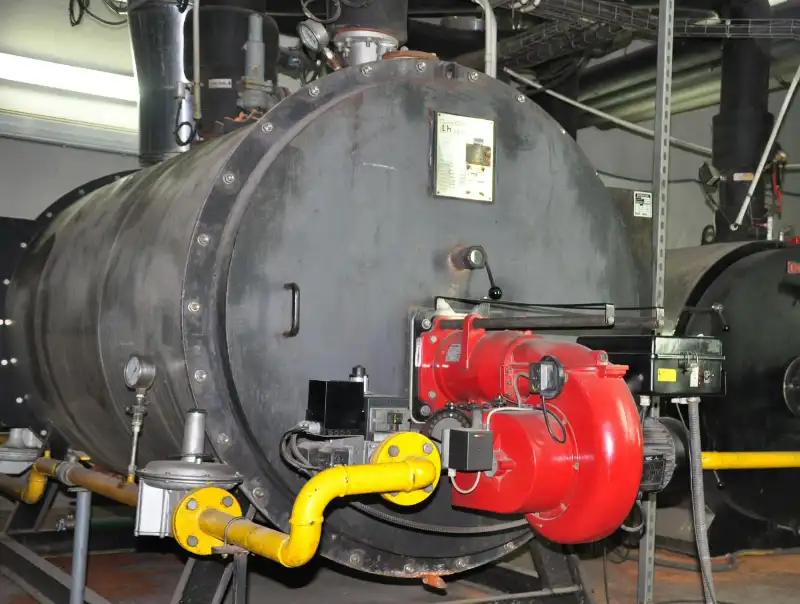
While a gas boiler has an efficiency of 85-105% (meaning it produces a maximum of 1.05 kWh of heat per kWh of gas), a modern air-source heat pump achieves a COP of 3 to 5 under favourable conditions. That means it produces between 3 and 5 kWh of heat for every kWh of electricity consumed.
In installations that operate with moderate flow temperatures (40-45 C, compatible with underfloor heating or low-temperature fan coils), the COP can exceed 4.5 for most of the heating season.
The economic comparison also depends on energy prices. With gas at EUR 0.07/kWh and electricity at EUR 0.18/kWh, the break-even point is at a COP of approximately 2.6. Above that figure, aerothermal energy is cheaper to run than a gas boiler.
What types of business benefit most?
Aerothermal energy is particularly well suited to:
- Hotels, guest houses and tourist apartments: high DHW demand year-round and a need for cooling in summer, which the same heat pump can provide.
- Care homes and social-healthcare centres: continuous demand for heating and DHW, with a very stable and predictable load profile.
- Offices and commercial buildings: especially those renovating older installations with gas boilers.
- Industrial premises with climate control needs that do not involve high-temperature processes.
- Schools and educational centres: heating demand concentrated in winter months, with a building structure often compatible with energy retrofit.
It is not the most appropriate solution where the production process requires steam or water above 80 C on a continuous basis, although high-temperature heat pumps capable of reaching 90 C or more are available.
Calculating the return on investment
The ROI of a commercial aerothermal installation depends on several factors: current consumption, gas and electricity prices, the actual COP of the equipment under operating conditions and any investment needed to adapt the heat distribution system.
Here is an indicative example for a business with an annual heat demand of 100,000 kWh:
| Item | Gas boiler | Aerothermal |
|---|---|---|
| Efficiency / COP | 95% | 3.5 seasonal average |
| Primary energy consumed | ~105,000 kWh gas | ~28,600 kWh electricity |
| Annual energy cost (gas EUR 0.07, electricity EUR 0.18) | ~EUR 7,350 | ~EUR 5,148 |
| Annual saving | — | ~EUR 2,200 |
With an installation cost of EUR 15,000-20,000, the simple payback period is between 7 and 9 years. If available incentives are applied, the timeframe is significantly shorter.
Incentives and financial support for business aerothermal systems
Several avenues of financial support currently exist for installing air-source heat pumps in the commercial and industrial sectors in Spain:
- PERTE Programme for Industry in Ecological Transition and other programmes from IDAE (the Institute for Energy Diversification and Saving), which subsidise energy efficiency and renewable energy projects for businesses.
- IVACE grants (Valencian Institute for Business Competitiveness) for companies in the Valencia region, with specific lines for energy retrofit and the replacement of gas boilers with renewable technologies.
- Tax deductions for energy efficiency investments, available through both corporate tax and energy saving certificates.
- Preferential financing through the ICO (Official Credit Institute) and financial institutions offering specific products for energy efficiency projects, which can significantly improve cash flow during the early years.
The conditions and amounts of these incentives change frequently, so it is advisable to consult an authorised installer who can advise you on the options available at the time of your project.
Technical installation requirements
For an aerothermal installation to perform as expected, several technical aspects require careful attention:
Flow temperature
Standard air-source heat pumps operate most efficiently with water flow temperatures between 35 C and 50 C. The most compatible heat distribution systems are:
- Underfloor heating: ideal, as it works with water at 35-40 C.
- Low-temperature fan coils: compatible provided the units are sized to work at those temperatures.
- Low-temperature radiators: large-surface aluminium panels, not conventional cast-iron radiators.
If the existing installation uses conventional radiators with water at 70-80 C, it may be necessary to replace or oversize them for the heat pump to operate efficiently.
Buffer tank and DHW storage
To stabilise the heat pump’s operation and prevent frequent start-stop cycles (which reduce both efficiency and compressor lifespan), a buffer tank is recommended. For DHW, a storage cylinder of the appropriate capacity is essential.
Outdoor unit location
The heat pump’s outdoor unit needs adequate ventilation to draw in air and expel cooler air. In high-capacity installations, the location must be carefully studied to avoid air recirculation that would reduce performance.
If your business is in Valencia or Aldaia and you want to know whether aerothermal energy is a good fit, visit our heating and DHW page for more information on the systems we install.
Maintenance of aerothermal systems
Air-source heat pumps require less maintenance than gas boilers, since there is no combustion or flue gas. The main tasks are:
- Cleaning the outdoor unit’s heat exchanger (at least once a year).
- Checking the refrigerant circuit for leaks.
- Monitoring electrical parameters of the compressor and fan.
- Verifying operating pressures and superheat levels.
- Inspecting the control system and programming.
A preventive maintenance contract with a specialist company ensures the equipment always operates at peak efficiency.
Conclusion: now is the time to make the switch
Aerothermal energy is not the future — it is the present. Businesses that are upgrading their heating installations are overwhelmingly choosing heat pumps, and the results in both energy consumption and CO2 emissions are highly significant.
If your business has a gas boiler that is more than 10 years old, or if you are planning a new installation, now is the time to calculate which option is most cost-effective in the long run. Contact us and our technical team will carry out a no-obligation comparative study so you can make the decision with all the facts on the table.