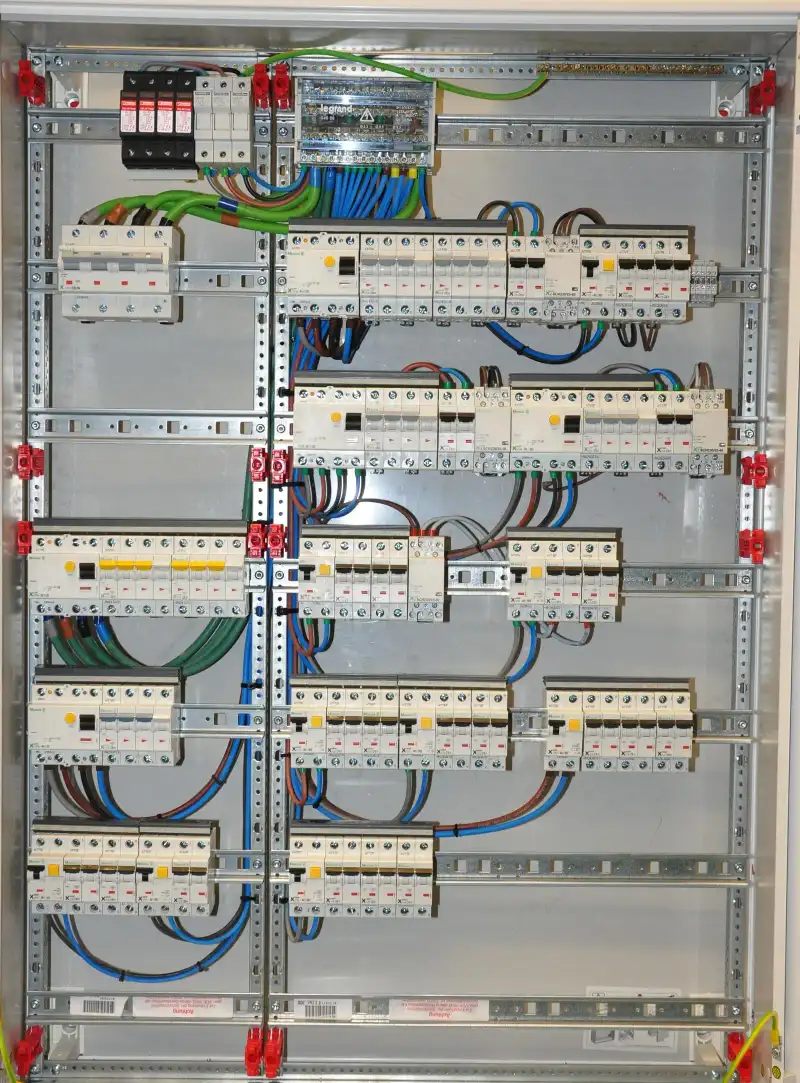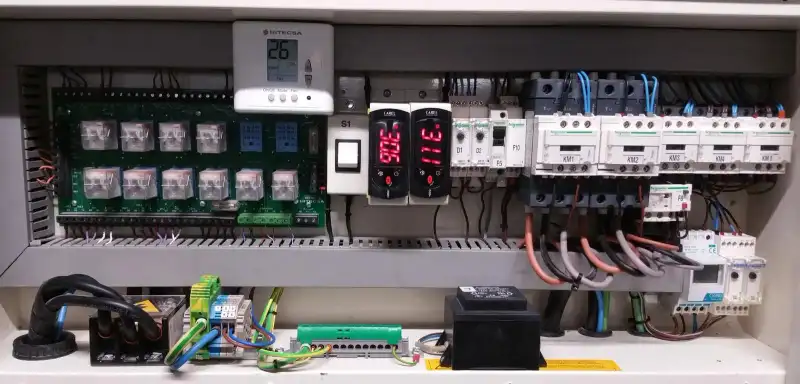
The electrical panel is the central nervous system of any industrial installation. Everything flows through it: the energy that powers production machinery, HVAC equipment, lighting and safety systems. And when it fails — or when it is simply poorly maintained — the consequences can range from an unplanned production stoppage to a fire with severe outcomes.
Yet the electrical panel is also one of the most overlooked elements in maintenance plans. It is installed, closed up and forgotten… until something goes wrong. This article explains what you need to know about industrial electrical panels, what the regulations require and how to keep them in optimal safety condition.
What an industrial electrical panel is and what it does
An industrial electrical panel is an assembly of switchgear and controlgear housed in a metal enclosure whose function is to distribute, protect and control electrical energy in an installation. Its main functions are:
- Distribution: divides the main supply into independent circuits for each zone or piece of equipment.
- Protection: incorporates devices that cut the supply in response to overcurrents, short circuits, earth leakage or overvoltages, protecting both the installation and people.
- Isolation: allows any part of the installation to be safely isolated for maintenance work.
- Control and switching: in more complex panels, includes motor starters, variable frequency drives, PLCs and automation elements.
Fundamental components
Main circuit breaker (IGA)
This is the first protective element after the supply connection. It protects the entire installation against overloads and short circuits and allows the complete supply to be manually disconnected. Its rating must be correctly sized in line with the contracted power and the installation.
Miniature circuit breakers (MCBs)
These protect each individual circuit against overcurrents and short circuits. They operate through a thermal effect (against sustained overloads) and a magnetic effect (against sudden short circuits). Correct selection — trip curve type, ampere rating, breaking capacity — is critical for the installation’s selectivity to work properly.
Residual current devices (RCDs)
These protect people against indirect contact by detecting earth leakage currents. The standard sensitivity is 30 mA for personal protection; in installations with high-frequency machinery or electronic equipment, 300 mA RCDs may be used to avoid nuisance tripping, provided personal protection is guaranteed by other means.
Fuses
In some industrial installations, fuses coexist with circuit breakers as a second line of protection. They are particularly common for protecting motors and transformers, where specific melting characteristics are required (aM or gG fuses).
Surge protection devices (SPDs)
Surge arresters or varistors protect sensitive electronic equipment against overvoltages of atmospheric or switching origin. They are mandatory in Category III and above installations under the REBT.
Variable frequency drives and soft starters
In industries with high-power motors, variable frequency drives allow progressive starting, avoiding current spikes and matching speed to actual demand. They represent one of the energy-saving measures with the highest return in industrial installations.
Applicable regulations: the REBT
The REBT (Reglamento Electrotecnico de Baja Tension), approved by Royal Decree 842/2002 and its Supplementary Technical Instructions (ITC-BT), is the fundamental regulatory framework for any low-voltage electrical installation in Spain.
The most relevant instructions for industrial panels are:
- ITC-BT-17: general switching and protection devices.
- ITC-BT-22: protection against overcurrents.
- ITC-BT-23: protection against overvoltages.
- ITC-BT-24: protection against direct and indirect contact.
- ITC-BT-47: motors.
For installations in locations with fire or explosion risk (industries handling gases, dusts or flammable liquids), the ATEX Directive and the corresponding UNE-EN standards also apply.
Industrial electrical panels must comply with the UNE-EN 61439 standard, which sets the construction, verification and marking requirements for low-voltage distribution assemblies.
Regulatory inspections
Industrial electrical installations with power above 100 kW are subject to periodic inspections by an Authorised Inspection Body (OCA) every five years. Non-compliance can lead to penalties and problems with activity permit renewals.
Maintenance plan: what to inspect and when
Monthly maintenance
- Visual check of overall condition: indicators, warning signals, unusual odours.
- Surface temperature check of the panel using a contact thermometer or a portable thermal imaging camera.
- Inspection of ventilation openings and enclosure filters.
Six-monthly maintenance
- Checking and tightening of terminals and connections (progressive loosening is a common cause of overheating and arc flash).
- Insulation resistance measurement on critical circuits.
- Functional test of RCDs using the test button.
- Interior cleaning of the panel using vacuum extraction (not compressed air, which can blow dust into components).
Annual maintenance
- Full thermographic inspection with an infrared camera: this is the most valuable tool for detecting hot spots before they cause a failure. A loose terminal, an oxidised contact or a partially blown fuse can be detected months before failure.
- Verification of protection calibration.
- Review of the electrical schematic: confirm that the documented schematic reflects the actual installation (especially in installations that have been modified).
- Testing of isolating and load-break devices.
- Earth resistance measurement.
Thermographic inspection: the technique that prevents fires
Infrared thermography is arguably the predictive maintenance tool with the highest return for industrial electrical installations. It allows detection of:
- Loose or poorly tightened connections (which generate contact resistance and heat).
- Load imbalances between phases.
- Fuses or MCBs with internal faults.
- Oxidised terminals with degraded continuity.
- Overloaded circuits.
Early detection of these hot spots prevents not only costly breakdowns but also fires, the frequency of which from electrical sources in industrial facilities is significant. Industry studies indicate that between 20% and 30% of fires in industrial warehouses originate from electrical causes.
Thermography must be carried out with the panel under load (ideally at 75-100% of normal load) and with the doors open in a controlled manner. The output is a report with thermal images, identification of anomalies and prioritised action recommendations.
Most common failures in industrial panels
- Loose terminal: causes hot spots, resistive losses and, in the worst case, arc flash. Common origin: machinery vibration or thermal expansion/contraction.
- RCD tripping with no apparent cause: may indicate deteriorating insulation in a circuit (rising leakage current) or the presence of network harmonics.
- General overheating: poor panel ventilation, installed power exceeding design capacity or saturated ventilation filters.
- MCB repeatedly tripping: may indicate a genuine circuit overload (solution: review the load and recalibrate the protection) or an MCB with the wrong trip curve for the load type.
- Corrosion on terminals or components: common in installations near the coast, in humid environments or where aggressive vapours are present.
Modifications and expansions: do it right from the start
One of the highest-risk situations in industrial installations is modifying the panel without a project or subsequent legalisation. Over the years, circuits are added, protections are replaced, new equipment is installed… and if all this is done without updating the electrical schematic or verifying that the panel still complies with regulations, the result is an opaque and potentially dangerous installation.
Any significant modification to an industrial electrical panel should be accompanied by an update of the single-line diagram and, when necessary, legalisation with the competent authority.
At Acoval we carry out the design, installation, legalisation and maintenance of industrial electrical installations in Valencia and the surrounding area. If you have concerns about the safety condition of your electrical panels or need to plan a thermographic inspection, get in touch through our contact page and we will advise you with no obligation.