Refrigeration is the single largest energy consumer in a supermarket. Depending on the size and type of store, it can account for 40% to 60% of the total electricity bill. For a chain with several locations in the Valencia region, that translates into hundreds of thousands of euros per year.
The good news is that there is real room for improvement. With the right decisions on equipment, design and maintenance, refrigeration energy consumption can be reduced by 20% to 40% without ever compromising food safety or customer comfort.
Types of display cases: the first efficiency factor
Open multi-deck cabinets (no doors)
These are the most common format in self-service supermarkets, particularly in the dairy, ready-meal and beverage sections. They offer maximum product visibility and ease of access, but they also have the highest energy consumption per linear metre: cold air continuously falls onto the aisle floor, creating convection currents that force the compressor to work intensively.
Glass-door multi-deck cabinets
Fitting doors on open cabinets is the single most impactful energy-saving measure and the one with the best cost-benefit ratio in commercial refrigeration. Depending on the study and installation type, the reduction in energy consumption can range from 30% to 50% in the affected sections.
Historical objections — reduced sales due to lower accessibility or visibility — have been refuted in numerous studies. With the right LED lighting and proper product layout, sales not only hold steady but in some cases actually improve, as doors are associated with a more carefully maintained store image.
Horizontal island cabinets (chest-style)
Typically used for frozen products. Less efficient in terms of consumption per linear metre than glass-door multi-decks, but top access significantly reduces cold loss compared to vertical open cabinets. Night covers or flexible lids reduce overnight energy consumption considerably.
Vertical display cases for meat and fish
These require precise temperature and relative humidity control to preserve product quality. Modern models incorporate controlled misting or humidification systems to maintain freshness without causing excessive condensation.
Centralised vs. distributed systems
Centralised refrigeration rack
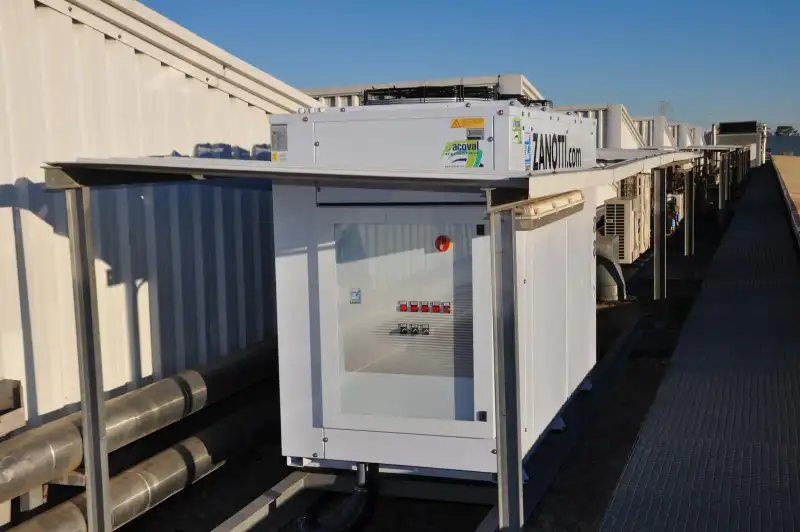
This is the standard system in medium and large supermarkets. A set of compressors, condensers and control components located in a plant room (usually on the roof or in the back-of-house area) supplies all display cases through a refrigerant piping network.
Advantages:
- Higher overall efficiency thanks to the economy of scale (large compressors are more efficient than many small ones).
- Maintenance concentrated at a single point.
- Ability to recover condensation heat for heating or domestic hot water (DHW).
- Centralised control of all parameters.
Disadvantages:
- Larger refrigerant charge in the system (relevant due to the EU F-Gas Regulation and the cost of the refrigerant itself).
- Greater impact if the main compressor fails.
- Higher initial investment.
Plug-in (self-contained) systems
Each cabinet has its own built-in refrigeration unit. These are common in small shops, convenience stores or premises where there is no space for a plant room.
Their individual efficiency is lower than that of a properly sized centralised system, and maintenance is multiplied because there are as many units as there are cabinets. However, they simplify installation and allow faster deployment.
CO2 refrigerant systems
CO2 (R-744) is becoming the benchmark refrigerant in supermarkets thanks to its environmental advantages (GWP of 1, compared with values of up to 3,900 for HFCs) and its efficiency in low-temperature applications. Transcritical CO2 systems are already the default choice for major European retail chains and are gaining ground rapidly in Spain, driven by the restrictions of the EU F-Gas Regulation.
Condensation heat recovery
The heat that supermarket condensers reject to the outside is not an unavoidable waste product: it is energy that can be put to use. Condensation heat recovery systems capture part of that heat and redirect it towards:
- Production of domestic hot water for cleaning the premises.
- Space heating during the colder months.
- Preheating the ventilation air supply.
In a supermarket with a medium-capacity refrigeration rack, heat recovery can cover between 60% and 100% of the hot water needs and significantly reduce heating energy consumption. The installation cost is typically paid back within 2 to 4 years.
LED lighting in display cases
Replacing fluorescent or incandescent lighting in display cases with LED not only reduces lighting energy consumption in its own right: it also lowers the thermal load inside the cabinet, since LED lamps generate far less heat than their conventional counterparts. This means the refrigeration equipment has to work less to maintain temperature.
The improvement in light quality (higher colour rendering index) also enhances product presentation, particularly in the meat, fish and fruit sections.
Night-time management: covers and differentiated setpoints
When the supermarket is closed, no customers need access to the cabinets. Yet many installations maintain the same operating conditions around the clock.
A few straightforward measures can significantly reduce overnight energy consumption:
- Night blinds or covers on open multi-deck cabinets: these cut consumption by 30-40% during closed periods.
- Relaxed temperature setpoints overnight: if the product is properly covered and there is no door opening, the target temperature can be raised slightly without compromising the cold chain.
- Optimised overnight defrost cycles: scheduling defrost cycles during the cheapest electricity hours and verifying that the frequency and duration are the minimum necessary.
Monitoring and centralised management
Continuous monitoring is the foundation of any efficiency strategy in commercial refrigeration. A centralised management system enables:
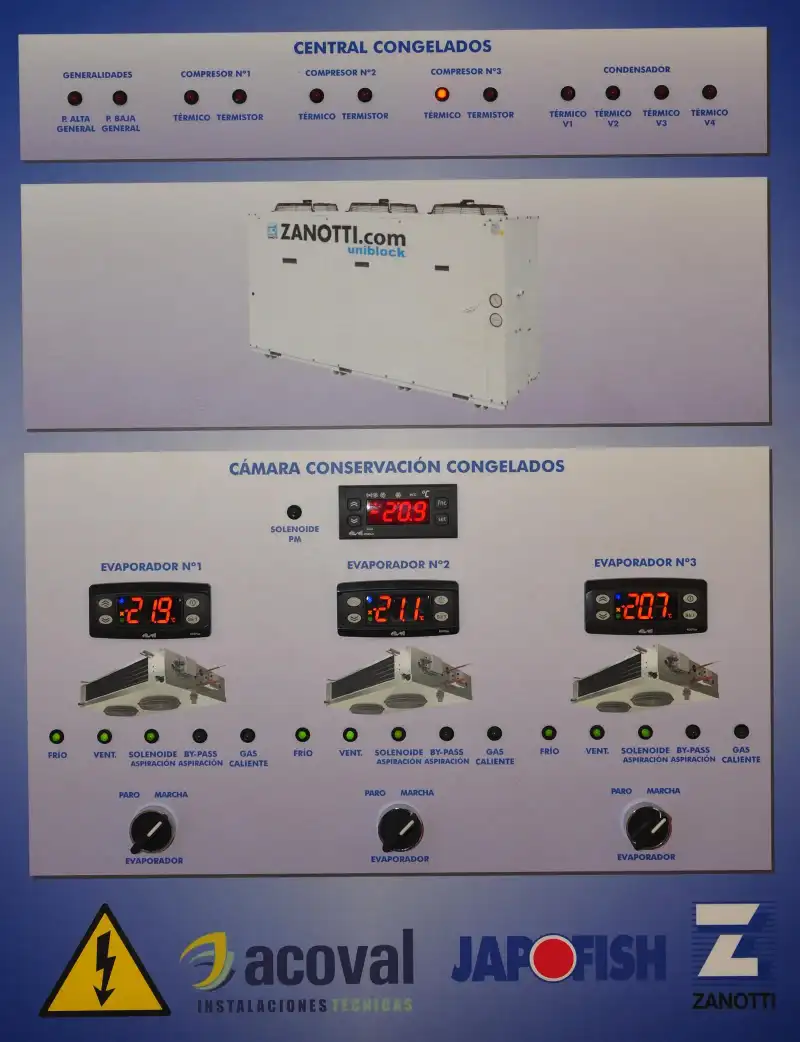
- Remote control of all parameters (temperature, pressure, compressor status, alarms).
- Immediate detection of deviations before they compromise food safety.
- Energy consumption analysis by zone, by equipment and by period, to identify inefficiencies and measure the impact of improvements.
- Temperature traceability for compliance with HACCP (Hazard Analysis and Critical Control Points) and food safety requirements.
- Automatic alerts for breakdowns or temperature exceedances, with notifications sent to the store manager or technical service.
The investment in a modern monitoring system pays for itself quickly, both through the energy savings it helps identify and through the reduction in product losses caused by undetected failures.
Preventive maintenance: the foundation of sustained efficiency
The efficiency of a refrigeration system is not static: it degrades over time if adequate maintenance is not carried out. The main degradation factors are:
- Dirty condensers: a film of dust or dirt on the condenser can increase energy consumption by up to 15%.
- Poor defrost performance: ice build-up on evaporators acts as insulation and reduces the efficiency of heat exchange.
- Refrigerant leaks: even small leaks reduce performance and raise consumption. The EU F-Gas Regulation requires periodic leak checks based on the refrigerant charge.
- Worn door seals: in glass-door cabinets, damaged seals negate much of the expected energy saving.
A structured preventive maintenance plan, with the right tasks and frequencies for each component, is the best investment for sustaining efficiency levels over time.
At Acoval we design, install and maintain industrial refrigeration and commercial cold systems for supermarkets, food stores and distribution chains. If you want to assess the improvement potential of your current installation or are planning a new store, get in touch through our contact page. We carry out a no-obligation technical and financial analysis.