Indoor air quality in industrial and commercial environments is not just a matter of comfort. It is a legal requirement, a safety condition for workers and a factor that directly affects productivity, accident rates and operating costs.
Yet industrial ventilation is often the great oversight in technical installation projects. The bare regulatory minimum is installed, sizing is not always correct and maintenance tends to be deferred until the problem is obvious. This article covers the key aspects that any technical manager or industrial facility owner should understand.
Regulatory framework: what the law says
RITE: Spain’s Building Thermal Installations Regulation
Royal Decree 1027/2007, which approves the RITE (Reglamento de Instalaciones Termicas en los Edificios), is the principal reference for HVAC and ventilation installations in commercial and industrial buildings. Its Technical Instruction IT 1.1.4.2 sets minimum outdoor air flow rates based on the required indoor air quality category:
- IDA 1 (optimal air quality): hospitals, nurseries, laboratories. Minimum flow rate of 72 m3/h per person.
- IDA 2 (good air quality): offices, residential, classrooms. 45 m3/h per person.
- IDA 3 (medium air quality): bars, restaurants, shops. 29 m3/h per person.
- IDA 4 (low air quality): spaces with infrequent use or controlled emissions.
For industrial spaces with specific contaminant generation (vapours, dust, fumes), the calculation is based on emissions rather than occupancy alone.
CTE: Spain’s Building Code
The Basic Document HS3 of the CTE (Codigo Tecnico de la Edificacion) regulates indoor air quality in residential buildings, and its calculation methodology serves as a reference for other uses. The DB SI (Fire Safety) also imposes ventilation requirements for smoke extraction in industrial warehouses.
Industrial Safety Regulations and sector-specific standards
For specific industries — food, chemical, pharmaceutical, woodworking — there are additional sector-specific regulations that may impose further ventilation, filtration and contaminant control requirements. Compliance with these requirements is a prerequisite for operating permits.
Types of industrial ventilation systems
Natural ventilation
Uses the pressure difference between indoors and outdoors and the stack effect (temperature difference) to renew the air. It is applicable in tall warehouses with roof openings (ridge vents, north-light roofs), but has obvious limitations: dependence on weather conditions, difficulty of control and poor effectiveness on hot or windless days.
Forced mechanical ventilation
Uses fans to supply or extract air, guaranteeing the required air flow rates regardless of external conditions. It is divided into:
- Forced extraction with natural intake: suitable for spaces with localised contaminant generation.
- Forced supply with natural exhaust: useful for creating positive pressure and preventing external contaminants from entering.
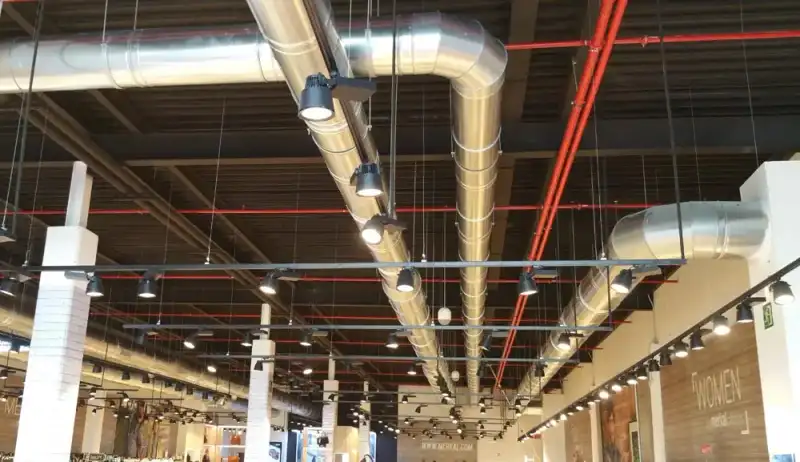
- Controlled mechanical ventilation (CMV) with dual flow: the most complete system, with mechanical supply and extraction and the ability to incorporate heat recovery.
Localised or source extraction
In industrial processes with contaminant generation at specific points (welding, painting, material cutting), the most efficient ventilation is source extraction: hoods or booths that capture the contaminant at the point of generation before it disperses into the general environment. This solution drastically reduces the required general ventilation flow rates and improves protection effectiveness.
HVAC systems with integrated ventilation
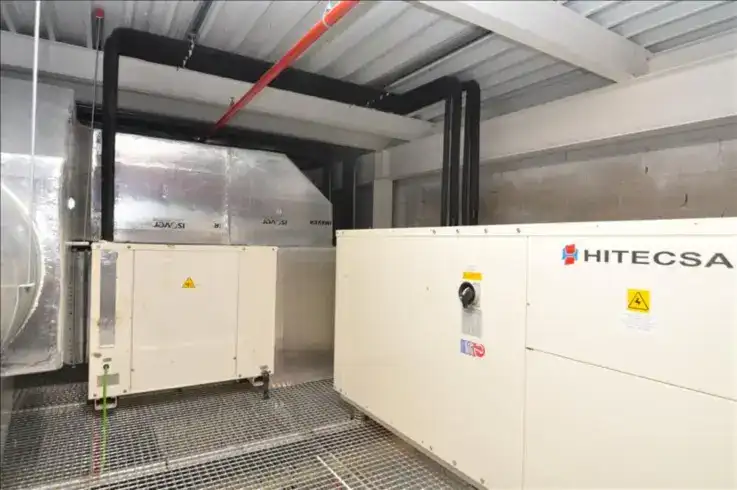
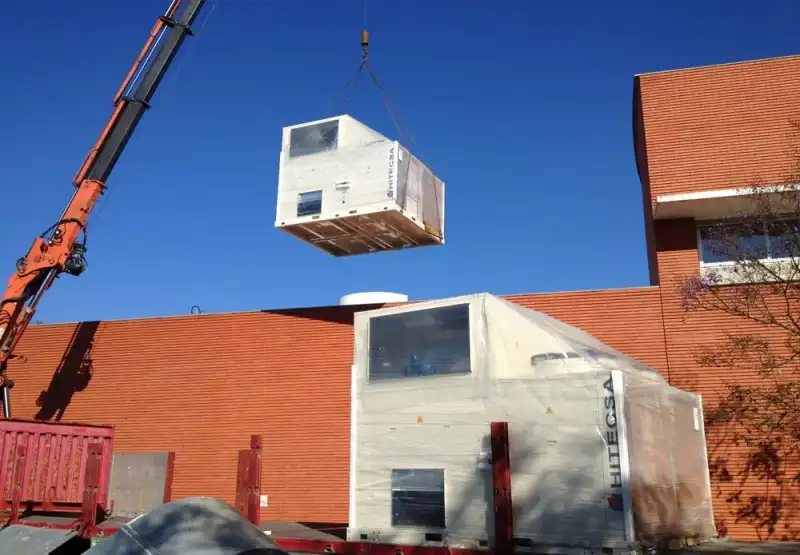
Rooftop units or AHUs (Air Handling Units) combine ventilation, filtration, heating and cooling in a single machine. They are the standard solution in large retail spaces, logistics warehouses and production centres in Valencia and the Aldaia area.
Air change rates: how to calculate them
The air change rate is expressed in air changes per hour (ACH) or in m3/h per person or per m2. The most common reference values in industrial environments are:
| Space type | Recommended ACH |
|---|---|
| Industrial offices | 4-8 ACH |
| Mechanical workshops | 10-20 ACH |
| Food industry (production areas) | 15-30 ACH |
| Warehouses with machinery | 6-12 ACH |
| Paint or varnishing booths | 60-100 ACH |
| Laboratories with chemical products | 10-15 ACH |
These values must always be adjusted according to the process type, contaminant load and the requirements of the applicable sector-specific regulations.
Air filtration
Filtration quality is just as important as air flow rate. The RITE establishes minimum filtration classes based on outdoor air category (ODA) and the required indoor air quality (IDA):
- G-class filters (coarse): capture large particles such as dust and fibres.
- M-class filters (medium): medium-efficiency filters, suitable for most commercial uses.
- F-class or HEPA filters (fine): high efficiency, required in pharmaceutical and food sectors or when IDA 1 is mandated.
A common mistake is installing the correct filters but not maintaining them. A saturated filter not only loses effectiveness but also increases resistance to air flow, forcing the fans to work harder and consuming more energy. Filters must be inspected and replaced at the intervals specified by the manufacturer, which in industrial environments can be as frequent as every two to three months.
Heat recovery: the highest-return measure
In installations with dual-flow controlled mechanical ventilation, heat recovery is the efficiency measure with the greatest impact. The principle is simple: the extracted air (warm in winter, cool in summer) transfers part of its energy to the supply air before being expelled, via a heat exchanger.
Modern heat recovery units achieve efficiencies of 70% to 90%, which can mean savings of between 20% and 40% on heating and cooling costs in spaces with high air change rates.
The investment in a heat recovery unit is typically paid back within 3 to 6 years in intensive-use installations and contributes significantly to meeting the energy efficiency targets required by European regulations.
Air quality monitoring
Regulations require certain air quality conditions to be guaranteed, but actually verifying that they are being met requires continuous monitoring. The parameters typically measured are:
- CO2: an indirect indicator of ventilation effectiveness. In workspaces, it should not exceed 1,000 ppm.
- VOCs (Volatile Organic Compounds): relevant in sectors using chemicals, paints or adhesives.
- Particulate matter (PM2.5 and PM10): critical in environments with cutting, sanding or material handling processes.
- Temperature and relative humidity: humidity should be maintained between 30% and 70% to avoid condensation problems, mould growth or effects on the product.
Modern control systems allow ventilation flow rates to be automatically regulated based on these parameters — demand-controlled ventilation — which reduces energy consumption when occupancy or contaminant load is low.
Best practices in maintenance
Maintenance of industrial ventilation systems is regulated by the RITE, which establishes minimum operations and frequencies. Beyond regulatory compliance, these practices help keep the system in optimal condition:
- Duct cleaning: at least every two years in normal environments; more frequently in food-sector or high-dust environments.
- Filter inspection and replacement: according to pressure differential or the manufacturer’s schedule.
- Air flow balancing checks: actual flow rates at each outlet should be verified periodically and adjusted if variations are found.
- Fan and belt inspection: bearing wear, belt tension, blade condition.
- Heat recovery unit checks: exchanger cleaning and verification of real efficiency.
Keeping all of this documented not only ensures regulatory compliance but also facilitates early problem detection and maintenance budget planning.
Why it is important to act now
Regulations on indoor air quality in work environments are becoming increasingly stringent, driven both by European regulation and by greater awareness of the relationship between the indoor environment and workers’ health and productivity.
Installations that do not meet current requirements face penalties, operating permit issues and, in the worst case, workplace accidents related to contaminant exposure.
At Acoval we design, install and maintain HVAC and ventilation systems tailored to the needs of each type of industry and activity. If you have questions about whether your installation meets current regulations, or if you want to improve the efficiency of your current system, write to us through our contact page. We carry out a no-obligation initial assessment.