From a thermal standpoint, a server room is an anomaly: it concentrates an extraordinary heat density in a small space, operates 24 hours a day, 365 days a year, and demands temperature and humidity conditions far more stringent than any other industrial or commercial environment. A cooling failure can bring equipment down within minutes, with financial losses potentially reaching thousands of euros per hour of downtime.
Yet many businesses still manage their server rooms with conventional air conditioning units that were never designed for this purpose. This article explains why data centre cooling requires a specialised approach and which technical solutions deliver the best results.
Thermal requirements for a data centre
The international reference standard for environmental conditions in data centres is ASHRAE TC 9.9, which sets the following recommended ranges:
- Air inlet temperature at equipment: between 18 degrees C and 27 degrees C (recommended range A1).
- Relative humidity: between 20% and 80%, with a maximum dew point of 15 degrees C.
- Rate of temperature change: below 5 degrees C per hour to prevent condensation and thermal stress on components.
These ranges may appear broad, but in a high-density server rack the temperature difference between air inlet and outlet can be 15 degrees C or more. If inlet air is already at 27 degrees C, the outlet may exceed 40 degrees C, creating problems for adjacent equipment if airflow is not properly managed.
Why a conventional air conditioner is not enough
Commercial HVAC units (split or multi-split systems) are designed to keep people comfortable, not to cool electronic equipment. The fundamental differences are:
- Sensible-to-latent heat ratio: in an office, a significant portion of the thermal load is latent heat (moisture generated by occupants). In a data centre, virtually 100% of the load is sensible heat generated by electronic equipment. A conventional air conditioner devotes part of its capacity to dehumidifying air that does not need it, wasting energy and over-drying the environment.
- Continuous operation: standard units are not built to run 24/7 year-round. Their compressors, fans and controls have duty cycles calculated for intermittent use.
- Control precision: a commercial split system maintains temperature within a 2-3 degrees C tolerance. A precision unit for data centres works within 0.5 degrees C.
- Redundancy: data centre cooling systems are always designed with redundancy (N+1 as a minimum) to ensure that a single equipment failure does not compromise the room.
Purpose-built cooling systems
Precision cooling units (CRAC/CRAH)
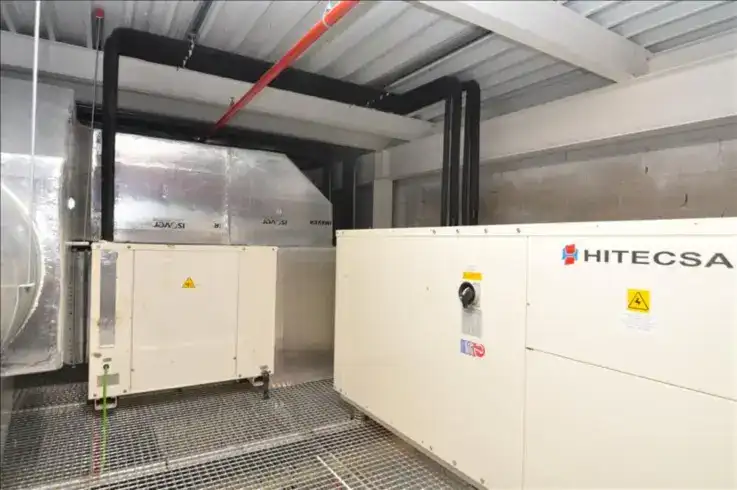
CRAC (Computer Room Air Conditioning) and CRAH (Computer Room Air Handler) units are the classic solution for medium-sized server rooms. They are installed within the room itself and distribute cooled air through a raised floor (hot aisle / cold aisle arrangement) or via ductwork.
- CRAC: incorporate their own compressor and refrigerant circuit. Suitable for rooms with up to 100-200 kW of thermal load.
- CRAH: use chilled water from an external chiller. More efficient for higher-capacity installations and allow the use of free-cooling techniques.
Hot aisle / cold aisle containment
Organising racks in alternating rows of cold aisles (air intake) and hot aisles (air exhaust) is the foundation of any efficient design. Enclosing hot or cold aisles with panels and doors prevents the mixing of cooled and heated air, dramatically improving system efficiency.
In-row cooling
For rooms with high-density racks (above 10 kW per rack), in-row cooling units are installed between racks, delivering localised cooling precisely where it is needed most. This approach shortens air transport distances and improves efficiency.
Free-cooling
Free-cooling uses outdoor temperatures to cool the room whenever conditions allow. In Valencia, where overnight temperatures drop below 15 degrees C for several months of the year, free-cooling can cover a significant proportion of operating hours, reducing cooling energy consumption by 20% to 40%.
Free-cooling systems can be direct (introducing filtered outdoor air) or indirect (heat exchange without air mixing), the latter being preferable in environments with strict air cleanliness requirements.
Energy efficiency: the PUE metric
The most widely used indicator for data centre energy efficiency is the PUE (Power Usage Effectiveness), calculated by dividing the facility’s total electrical consumption by the consumption of IT equipment alone:
- PUE = 2.0: for every watt consumed by IT equipment, another watt goes to cooling, lighting and other ancillary systems. This is typical of older or poorly designed facilities.
- PUE = 1.5: a good level of efficiency, achievable with precision cooling and sound design practices.
- PUE = 1.2-1.3: excellent, achieved through free-cooling, aisle containment and advanced controls.
Cooling is usually the largest contributor to PUE after the IT equipment itself, which means any improvement in the cooling system has a direct and measurable impact on operating costs.
Monitoring and control
A data centre without monitoring is a constant risk. Parameters that should be tracked continuously include:
- Temperature at multiple points: inlet and outlet of each rack, cold aisle, hot aisle, return air to cooling units.
- Relative humidity: at least in cold aisles and at the return.
- Raised floor differential pressure: ensures correct airflow distribution.
- Cooling equipment status: operating temperatures, refrigerant circuit pressures, filter condition, alarms.
- Electrical consumption: to calculate real-time PUE and detect deviations.
Building Management Systems (BMS) or Data Centre Infrastructure Management (DCIM) platforms collect these data and generate automatic alerts when any parameter moves out of range, enabling action before a thermal issue affects equipment.
Redundancy and continuity
The basic rule in data centre cooling is that the failure of a single unit must never compromise the room. This means:
- N+1 redundancy: if the load requires three cooling units, four are installed. If one fails, the remaining three cover the full demand.
- Uninterruptible power supply (UPS): the control systems and fans of cooling units must be connected to the data centre’s UPS.
- Backup generator: in mission-critical data centres, cooling must be able to run on generator power for as long as necessary.
Planning and sizing
The most common mistake in server room cooling is sizing the system for current load without anticipating growth. The thermal output of IT equipment has risen steadily over recent decades, and a data centre with adequate headroom today can reach saturation within two or three years if expansion has not been planned for.
Correct sizing starts with a detailed analysis of the current thermal load, projected growth, local climate conditions and the availability requirements of the business.
At Acoval Technical Installations we design and install precision cooling systems for server rooms and data centres across Valencia and the wider Valencian Community. From SMEs with a single mission-critical comms cabinet to larger-scale data centres, we tailor the technical solution to the level of availability each client requires. If you want to evaluate your current setup or plan a new project, get in touch through our contact page.