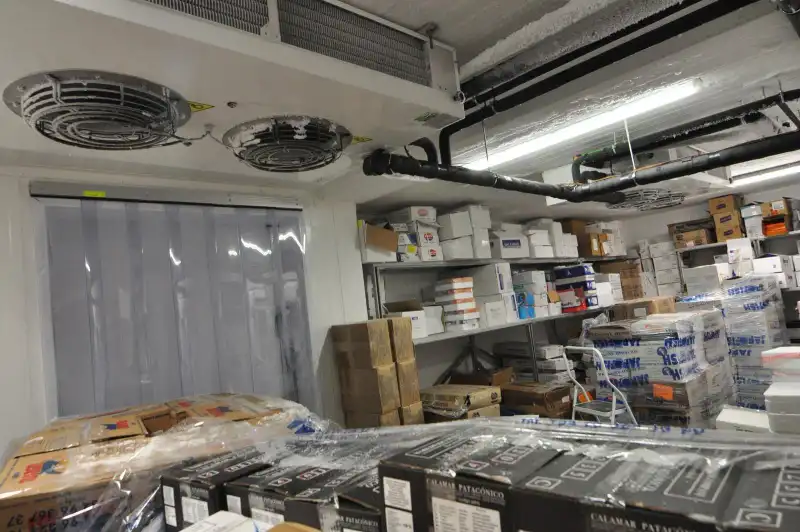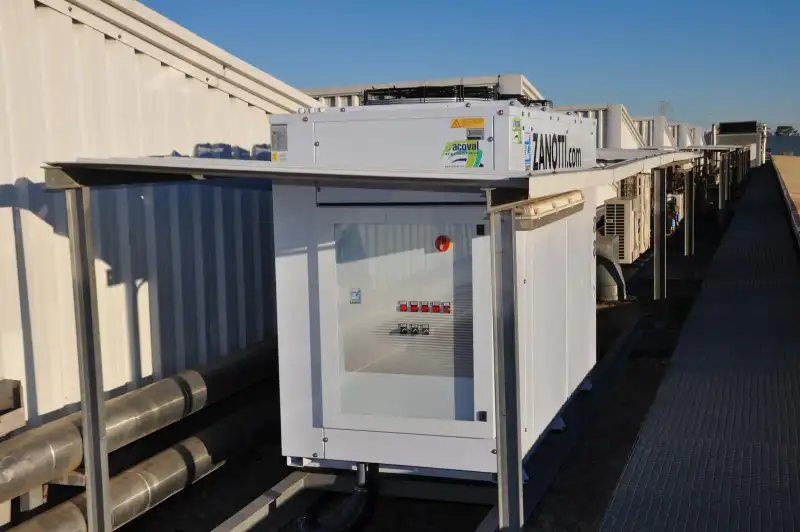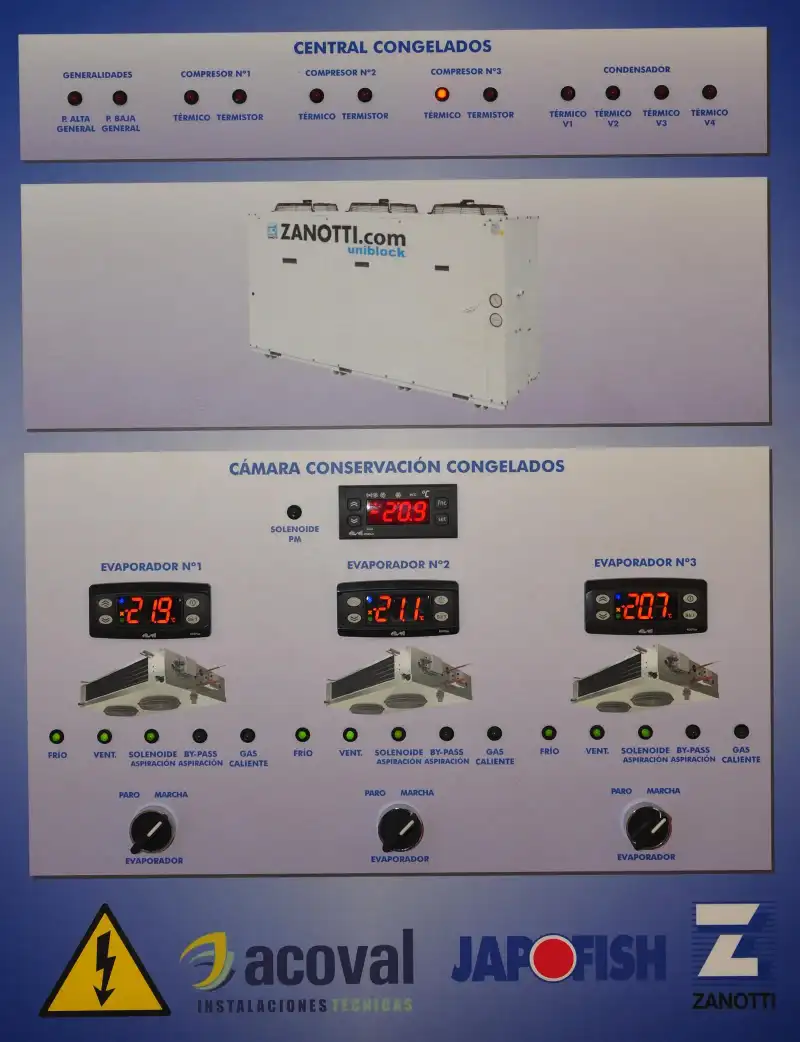
Choosing the right industrial refrigeration equipment is a decision that determines the efficiency, reliability and operating costs of an installation for 15 to 20 years. A selection error is not easily corrected: an oversized unit consumes more than necessary, an undersized one fails to reach the required temperatures and the wrong compressor type for the application has a shorter lifespan.
This guide reviews the main types of industrial refrigeration equipment available on the market, their operating principles, advantages, disadvantages and the applications for which each is best suited.
Pre-selection criteria
Before comparing equipment, the installation requirements must be precisely defined:
- Operating temperature: a conservation room at +2 C is very different from a freezer at -25 C. The evaporating temperature determines the compressor type and refrigerant.
- Required cooling capacity: measured in kW, it depends on the total heat load (product, building envelope, infiltration, lighting, personnel).
- Number of services: how many rooms, how many cooling lines, and what temperature each needs.
- Operating regime: continuous (24/7) or intermittent. Demand simultaneity across different rooms influences system sizing.
- Refrigerant: the F-Gas Regulation and market trends are pushing towards low-GWP refrigerants (CO2, ammonia, propane) over traditional HFCs.
- Available space: for the plant room, condensing units and pipework runs.
Types of industrial refrigeration systems
Compact (plug-in) systems
These are self-contained units that integrate all refrigeration cycle components (compressor, condenser, evaporator, expansion valve) in a single module or two prefabricated units. They connect to the mains and are ready to operate.
Key characteristics:
- Typical capacities of 1 to 15 kW cooling.
- Factory-sealed refrigerant charge, with no on-site brazing or charging.
- Quick installation, with no plant room required.
- Simple maintenance.
Advantages:
- Low installation cost.
- Very short commissioning time.
- Ideal for expansions or temporary solutions.
Disadvantages:
- Lower energy efficiency than centralised systems.
- Higher noise level due to the integrated compressor.
- Shorter lifespan under intensive use.
Typical applications: cold rooms in restaurants, small warehouses, food shops, bakeries.
Split systems (condensing unit + evaporator)
Similar to a domestic air conditioning concept but in a refrigeration version: the compressor and condenser are located outdoors, while the evaporator is installed inside the cold room, connected by refrigerant pipework.
Key characteristics:
- Capacities of 2 to 30 kW cooling.
- Lower indoor noise since the compressor is separated from the room.
- Requires a qualified refrigeration engineer for the refrigerant charge and brazing.
Advantages:
- Good balance between cost and performance.
- Lower noise level inside the room.
- Wide range of capacities and manufacturers.
Disadvantages:
- Requires copper pipework runs between units.
- More sensitive to distance and height difference between units.
Typical applications: medium-sized conservation and freezer rooms, convenience supermarkets, small-scale food industry.
Centralised multiplex racks
A refrigeration rack is a set of compressors mounted on a common frame that serve multiple evaporators (cold rooms, display cases, cabinets) through a pipework network. The compressors operate in cascade according to demand, optimising overall performance.
Key characteristics:
- Capacities from 20 kW to several hundred kW.
- Multiple compressors with automatic sequencing.
- Centralised condensing (air-cooled condenser on the roof or evaporative condenser).
- Centralised control of all parameters.
Advantages:
- Maximum energy efficiency through economies of scale.
- Redundancy: if one compressor fails, the others take over the load.
- Maintenance concentrated at a single point.
- Potential for condenser heat recovery.
Disadvantages:
- Higher initial investment.
- Requires a plant room with adequate ventilation and access.
- Larger refrigerant charge in the installation.
- More complex installation and longer commissioning period.
Typical applications: medium and large supermarkets, food industry, logistics platforms, fruit and vegetable packing centres.
Compressor types: technical comparison
The compressor is the heart of any refrigeration system. Its type determines the power range, efficiency, noise level and system lifespan.
Hermetic compressor
The motor and compression mechanism are sealed inside a welded casing. It is not repairable: if it fails, the entire unit is replaced.
- Capacity: up to 10-15 kW cooling.
- Advantage: low cost, low noise, no shaft seal leaks.
- Disadvantage: not repairable, limited in capacity.
- Typical use: compact units, small cold rooms.
Semi-hermetic compressor
The motor and mechanism are inside a bolted casing that allows access for repair or replacement of internal components.
- Capacity: 5 to 150 kW cooling.
- Advantage: repairable, good efficiency, wide power range.
- Disadvantage: higher initial cost, larger footprint.
- Typical use: centralised racks, medium and large cold rooms.
Scroll compressor
Uses two scrolls (one fixed and one orbiting) to compress the refrigerant gas. It has no suction or discharge valves, reducing wear points.
- Capacity: 3 to 40 kW cooling per unit.
- Advantage: very quiet, few moving parts, high reliability, excellent part-load efficiency with inverter models.
- Disadvantage: not repairable (hermetic), limited power range.
- Typical use: positive-temperature racks, HVAC, heat pumps.
Screw compressor
Two helical rotors (male and female) trap and compress gas continuously. It is a positive displacement compressor with very smooth operation.
- Capacity: 50 kW to over 1,000 kW cooling.
- Advantage: high efficiency, continuous capacity modulation (10% to 100%), long lifespan, suited to large loads.
- Disadvantage: high cost, requires lubrication system and oil separator.
- Typical use: large refrigeration racks, food industry, large-scale logistics, blast freezing tunnels.
System comparison table
| Criterion | Compact | Split | Centralised rack |
|---|---|---|---|
| Cooling capacity | 1-15 kW | 2-30 kW | 20-500+ kW |
| Energy efficiency | Medium | Medium-high | High |
| Initial investment | Low | Medium | High |
| Operating cost (kWh/kW cooling) | High | Medium | Low |
| Redundancy | None | None | High |
| Expansion flexibility | Low | Medium | High |
| Installation complexity | Minimal | Medium | High |
| Indoor noise level | High | Low | Low |
| Typical lifespan | 8-12 years | 12-18 years | 15-25 years |
Refrigerants: the regulatory variable
Equipment selection is increasingly influenced by refrigerant regulations. The European F-Gas Regulation mandates a progressive reduction in the use of high-GWP HFCs, accelerating the transition towards:
- CO2 (R-744): GWP of 1. Already the standard in supermarket centralised racks. Excellent at low temperatures, requires high working pressures.
- Ammonia (R-717): GWP of 0. Used in large industrial installations. Toxic and flammable, requiring plant rooms with specific safety measures.
- Propane (R-290): GWP of 3. Used in low-charge compact units. Flammable, limiting the refrigerant quantity per circuit.
Refrigerant selection is not independent of equipment choice: each compressor type and system configuration is designed to work with specific refrigerants.
The importance of correct sizing
Oversizing an industrial refrigeration installation is as damaging as undersizing it. An oversized unit starts and stops frequently (short cycling), which reduces its lifespan and worsens efficiency. An undersized unit works at its limit permanently, fails to reach the set temperatures and wears out prematurely.
Correct sizing starts with a rigorous heat load calculation that considers the stored product, entry conditions, the room envelope, door-opening infiltration, interior lighting and a reasonable safety margin (normally 10-15%).
At Acoval, we design, install and maintain industrial refrigeration systems for food, logistics, hospitality and industrial businesses in Valencia and the Valencian Community. If you need advice on choosing the most suitable equipment for your operation, contact us and we will carry out a no-obligation technical assessment.