Climate-controlling an industrial warehouse is a challenge of a very different magnitude from that of a commercial premises or an office. The volumes are enormous, thermal loads can be very high, production activity generates residual heat and the comfort or process requirements vary from one zone to another.
Choosing the right solution from the outset makes the difference between a system that works well for years and one that consumes more than it should, causes recurring problems or fails to achieve the required working conditions.
The specific challenges of large industrial spaces
Before selecting the HVAC system, it is essential to understand the factors that shape the design:
- Internal clear height: warehouses typically range from 6 to 14 metres in height. Heat tends to accumulate at the top, so the air distribution must be designed to reach the working zone effectively.
- High internal loads: machinery, motors, furnaces or transformation processes generate large amounts of heat that the HVAC system must absorb.
- Hygienic ventilation: the RITE (Reglamento de Instalaciones Termicas en los Edificios — Spain’s Building Thermal Installations Regulation) sets minimum ventilation rates that must be integrated into the design.
- Differentiated zones: a warehouse may have a production area, storage, offices and loading/unloading bays, each with different requirements.
- Poor building envelope: many older warehouses have roofs and cladding with minimal insulation, which drives up heat losses and gains.
RITE compliance in industrial installations
The RITE, approved by Royal Decree 1027/2007 and subsequently updated, sets the technical requirements that all HVAC and heating installations in Spain must meet.
For warehouse installations, the most relevant aspects are:
- Minimum seasonal efficiency of heating and cooling generators.
- Installation control: any system rated above 70 kW must incorporate automatic temperature control in each zone or area.
- Periodic inspections: installations above 12 kW must be inspected by an Authorised Inspection Body (OCA) at intervals that vary according to capacity.
- Technical documentation: a project signed by a qualified engineer and the installation certificate.
Having documentation in order is not only mandatory; it also facilitates access to grants and financing for energy efficiency improvements.
HVAC systems for industrial warehouses
There is no one-size-fits-all solution. Below is an overview of the most common options and their application conditions.
Rooftop units
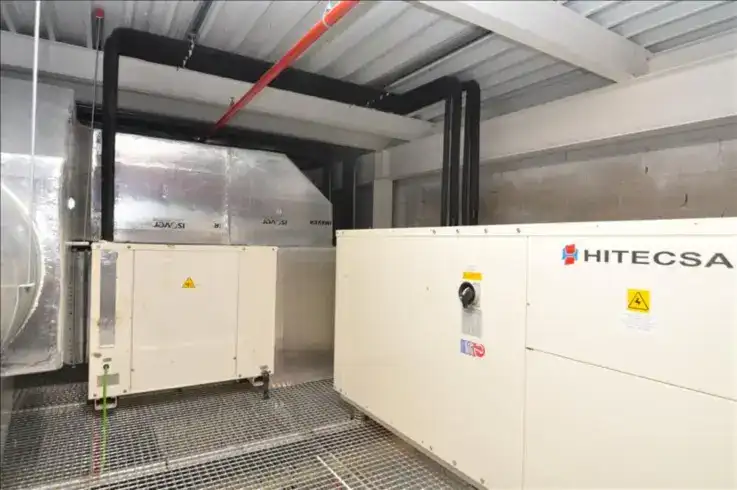
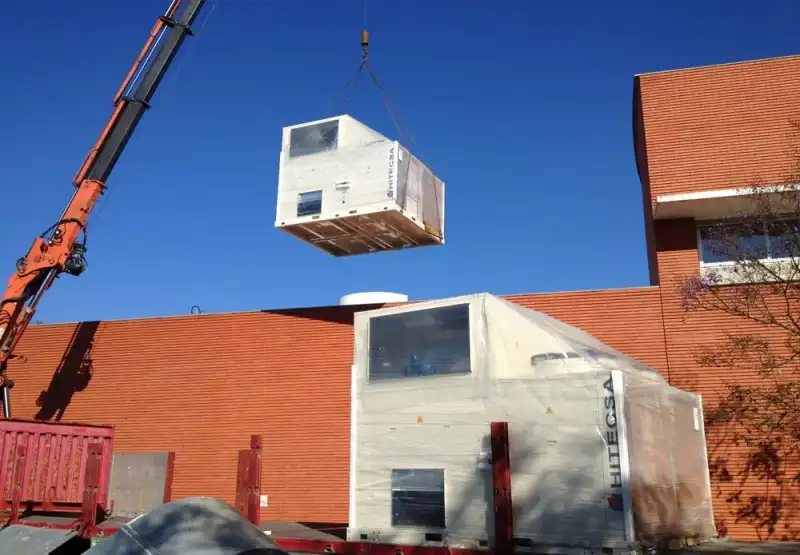
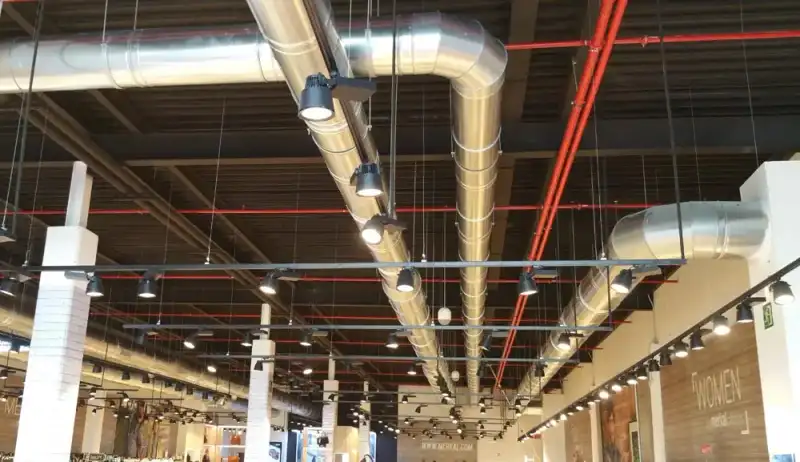
Rooftop units are compact air handling units installed on the warehouse roof that distribute treated air through ductwork. They are the most widespread solution in medium-sized warehouses for several reasons:
- They integrate the compressor, condenser, evaporator and, in many cases, the ventilation system into a single unit.
- They occupy no interior space.
- They are relatively easy to maintain.
- Models with free-cooling are available, which use outside air when conditions allow to cool without mechanical compression.
Their main limitation is air distribution: in very long warehouses or those with complex layouts, the ductwork design can be demanding.
Evaporative cooling
In hot, dry climates such as Valencia’s, evaporative cooling is a highly efficient option for warehouses where the production process tolerates some variation in humidity. It works by passing air through a wet medium, which can lower the air temperature by 8 to 12 C with very low electrical consumption (only the fan motor).
Its main advantages:
- Consumption 5 to 10 times lower than a mechanical compression system.
- Supplies 100% outside air, improving indoor air quality.
- Low maintenance cost.
It is not suitable for warehouses with high internal humidity, for processes sensitive to humidity or when precise temperature control is required.
VRF / VRV systems
Variable Refrigerant Flow (VRF/VRV) systems are the standard solution when the warehouse includes office areas, plant rooms or spaces that require individual temperature control. They allow multiple indoor units to operate in heating or cooling mode simultaneously and independently, all served by a single outdoor unit.
They are highly efficient in buildings with diverse loads and different orientations, but their installation cost is higher than that of centralised systems.
Ducted systems with AHUs
Air Handling Units (AHUs) are the reference solution when temperature, humidity, ventilation and air filtration must be rigorously controlled. They are particularly suited to warehouses with production processes that demand stable environmental conditions (pharmaceutical, food, electronics industries).
Energy efficiency strategies
The cost of climate-controlling an industrial warehouse can be very significant. These measures help reduce it:
- Improving roof insulation: a poorly insulated roof can be responsible for 40-60% of heat gain in summer. An insulation upgrade can drastically reduce the load on the HVAC system.
- Assisted natural ventilation: correctly oriented roof lights and ridge vents allow hot air accumulated at the top of the warehouse to be extracted without electricity consumption.
- Heat recovery: equipment with enthalpy recovery units reuses the energy from extracted air to preheat or precool the incoming air, cutting the installation’s consumption.
- Smart management: time-based scheduling, zone-based programming and integration with building management systems (BMS) allow the installation’s operation to be matched to actual needs at any given time.
If you are looking for an industrial HVAC solution in Valencia or the Valencian Community, at Acoval we carry out the load study, technical project, installation and maintenance of HVAC systems for industrial warehouses of any size.
Maintenance: key to longevity and efficiency
An industrial HVAC system without maintenance loses efficiency progressively. Clogged filters, dirty heat exchangers or an incorrect refrigerant charge can increase consumption by 20-30% and shorten equipment lifespan.
The RITE establishes a minimum mandatory maintenance programme according to the installation’s capacity, which includes:
- Cleaning of filters and heat exchanger coils.
- Leak-tightness checks on the refrigerant circuit.
- Verification of electrical and mechanical parameters.
- Inspection of control systems.
HVAC as a competitive advantage
A well-climate-controlled warehouse does not only comply with regulations: it improves working conditions, reduces absenteeism, protects stored equipment and products and can be a differentiating factor against the competition.
If you want to explore the options available for your warehouse or have been struggling with a system that is not performing correctly, get in touch and we will carry out a no-obligation technical visit to assess your situation and offer you the best solution.