The design of a wine cellar does not start with the walls or the furniture. It starts with the environmental conditions that the wine needs at each stage: fermentation, ageing, storage and conservation. If the climate control system is not properly sized and adapted to each zone, everything else loses its purpose.
An incorrect temperature during ageing can accelerate or halt the maturation process irreversibly. Poorly controlled humidity promotes evaporation or mould growth. And an oversized unit that constantly starts and stops generates fluctuations which, accumulated over time, degrade the product.
Designing climate control for a winery is a technical discipline that combines refrigeration engineering, oenological knowledge and hands-on field experience.
Reference temperatures and humidity levels by wine type
There is no single temperature for the entire cellar. Each process and each type of wine has its own environmental requirements.
Red wines
Reds undergoing barrel ageing require barrel rooms maintained between 12 C and 16 C, with relative humidity of 70% to 80%. This range promotes controlled micro-oxygenation through the wood and allows tannins to evolve gradually.
During fermentation, red musts are worked at between 24 C and 28 C to maximise extraction of colour, anthocyanins and tannins. Active refrigeration in the tanks is essential to prevent the temperature from rising above 30 C, which could halt fermentation or produce cooked aromas.
White and rose wines
White and rose fermentation is conducted at lower temperatures, between 14 C and 18 C, to preserve varietal aromas and acidity. These processes demand greater heat extraction capacity, as the difference between the must temperature and the ambient temperature can be significant during warm months.
For storage and conservation, bottled whites and roses are maintained under conditions similar to reds: between 10 C and 14 C, in darkness and free from vibration.
Sparkling wines and cavas
Sparkling wines are particularly sensitive to temperature changes, as variations affect the internal pressure of the bottle and can compromise the closure. The storage area must be maintained between 8 C and 12 C, with high thermal stability and no sudden swings.
The barrel room: the most demanding zone
The barrel ageing room is, from a climate perspective, the most critical zone in the entire winery. The climate control system must simultaneously meet requirements for temperature, humidity and air renewal.
Humidity control
Relative humidity between 70% and 80% serves a specific purpose: limiting evaporation loss through the barrel. A 3% annual loss is normal and acceptable; if humidity drops below 60%, evaporation accelerates and both volume and quality are lost. Above 85%, the risk of mould on the wood and on cork closures rises significantly.
Climate control equipment for barrel rooms must incorporate active humidification and dehumidification, not just temperature control.
Air renewal
Controlled air exchange is necessary to prevent the accumulation of CO2 — which is produced in barrels during ageing — and to keep the environment free from foreign odours that the wine could absorb through the wood.
Bottle storage: stability above all
Once the wine is bottled, the needs change. The priority is not a very strict thermal range, but stability over time. Sudden temperature changes are the main enemy of bottled wine: they cause the liquid to expand, put pressure on the cork and ultimately facilitate oxygen ingress.
Bottle storage areas must be sized to maintain uniform temperatures, with equipment that operates continuously and gradually rather than cycling on and off frequently.
Equipment selection: beyond the standard split unit
A standard domestic or commercial HVAC unit is not suitable for a professional winery. The reasons are technical: the operating temperature range, humidity control capability and reliability in continuous operation all require dedicated solutions.
The most common systems in wineries include:
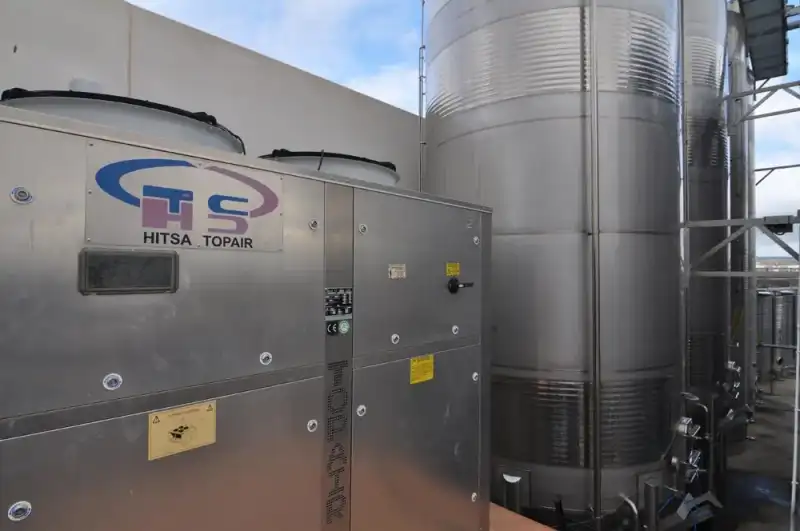
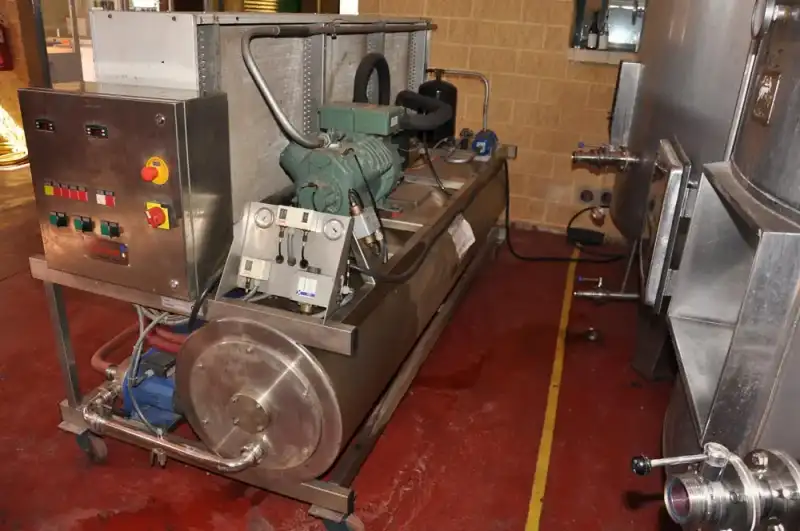
- Water chillers: generate chilled water that circulates through fermentation tank jackets and through room air handler coils. They are the central element of the refrigeration installation.
- Glycol-water circuits: essential when working with temperatures below 4 C, such as cold tartaric stabilisation. The water-glycol mixture prevents freezing in the circuit.
- Precision climate units: units that control temperature and humidity simultaneously, designed to operate within narrow ranges with high stability.
- Direct expansion units with electronic control: suitable for small to medium wineries where the cost of a centralised installation is not justified.
Insulation: the invisible foundation
The most efficient climate control system in the world loses effectiveness if the building is poorly insulated. In wine cellar design, the thermal and hygrothermal insulation of walls, ceilings and floors is as important as equipment selection.
The most widely used materials are sandwich panels with a polyurethane core, spray-applied polyurethane foam insulation and, in high-end solutions, combined insulation with vapour barriers. An air gap between the insulation and the outer cladding adds an additional layer of protection.
Correct insulation design reduces the thermal load that the equipment must compensate, which allows equipment to be sized downward, saving on initial investment and reducing electricity consumption throughout its service life.
Backup and safety systems
In a winery with its own production, a climate control system failure during the harvest can mean losses of tens of thousands of euros within hours. That is why the design must always include safety mechanisms:
- Partial redundancy: at least one backup unit for the most critical zones.
- Remote alarms: monitoring systems that alert in case of temperature or humidity deviation, accessible from the manager’s mobile phone.
- Emergency generators: in wineries with critical production, a standby generator that activates automatically during a power cut is a justified investment.
Integrated design from the first drawing
The greatest efficiency is achieved when the climate control system is designed alongside the building, not as an afterthought. Defining the winery’s zones from the outset, the thermal loads for each space, the refrigerant circuit routes and the equipment locations allows both investment and consumption to be optimised.
At Acoval we have been designing and installing climate control systems for wine cellars in Valencia and the Valencian Community for years. Each project starts with a detailed technical analysis of the winery’s real requirements: wine types, production volume, process stages and the local climate conditions.
If you are planning a new winery or need to review and upgrade your current installation, we can help you design a technical solution that protects the quality of your wine at every stage. Get in touch and tell us about your project.