For decades, natural gas has been the dominant energy source in European industry for heating, hot water production, thermal processes and, in many cases, cogeneration. It was a logical choice: competitive pricing, reliable supply, mature technology and a regulatory framework that favoured it over electricity for thermal applications.
That landscape has changed. Gas prices have lost their historic stability, European regulation is pushing hard towards decarbonisation, electrification technologies have matured to the point of being competitive on both cost and performance, and solar photovoltaic self-consumption has opened the possibility of generating part of the electricity consumed at near-zero marginal cost. The question is no longer whether industry will electrify, but when and how to do it intelligently.
This article examines the technical and economic factors that industrial businesses should consider when planning this transition.
Why electrification is inevitable
European regulation
The European Green Deal sets the objective of achieving climate neutrality by 2050, with an intermediate target of a 55% reduction in greenhouse gas emissions by 2030 compared to 1990 levels. For industry, this translates into:
- A rising price for CO2 emission allowances on the EU Emissions Trading System (ETS), which already exceeds EUR 50 per tonne and is expected to continue climbing.
- Progressive restrictions on the use of fossil fuels in certain applications.
- Increasingly stringent energy efficiency requirements.
- Financial and fiscal incentives for electrification and renewable energy.
Gas price volatility
The 2022 energy crisis exposed the vulnerability of European economies to dependence on imported natural gas. Although prices have moderated since the peaks of that year, structural volatility has become a permanent feature. For an industrial business, uncertainty in energy costs is an operational risk that electrification — especially when combined with self-consumption — can significantly mitigate.
Technology maturity
Industrial heat pumps, high-efficiency electric heating systems, thermal storage and photovoltaic self-consumption are now mature technologies. Costs have fallen significantly over the past decade, and the ecosystem of manufacturers, installers and maintenance providers is well established.
Key technologies for the transition
Industrial heat pump
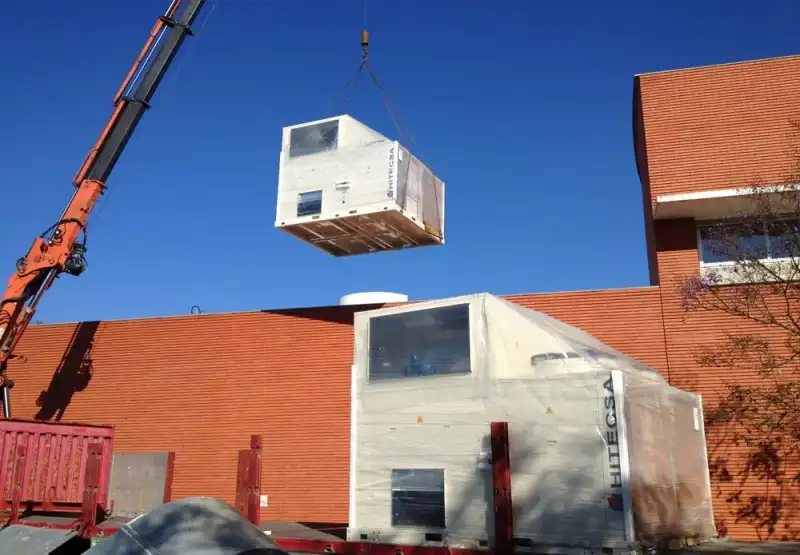
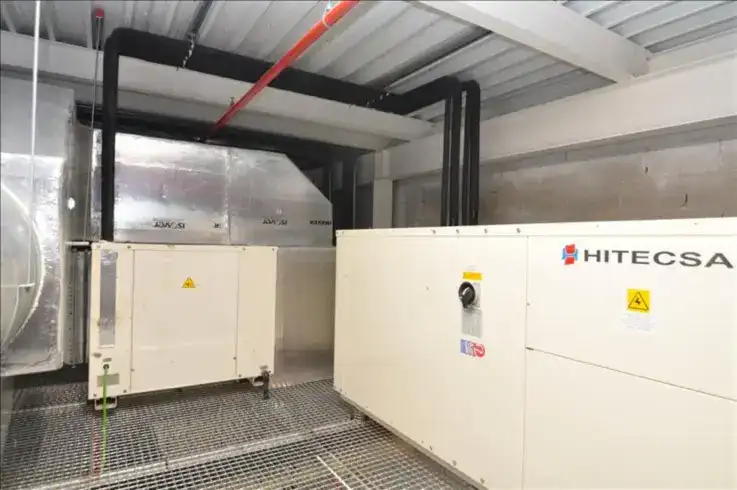
The heat pump is the central technology for electrifying industrial thermal applications. Its operating principle enables it to generate between 2.5 and 5 kWh of heat for every 1 kWh of electricity consumed (COP of 2.5 to 5), making it significantly more efficient than any combustion-based system.
Industrial heat pump applications include:
- Building and warehouse heating: replacing gas boilers with air-to-water or water-to-water heat pumps feeding unit heaters, underfloor heating or fan coils.
- Domestic hot water (DHW) production: dedicated heat pumps with storage tanks, capable of producing water at 60-70 degrees C with COP values above 3.
- Low and medium temperature processes: industrial washing, drying, pasteurisation. High-temperature heat pumps (HT-HP) can reach 90-100 degrees C, and models exceeding 120 degrees C are under development.
- Waste heat recovery: heat pumps can capture waste heat from refrigeration processes, air compressors or industrial effluents and raise it to a useful temperature.
In Valencia’s Mediterranean climate, air-source heat pumps operate at optimal efficiency for most of the year, since outdoor temperatures rarely drop below 3-5 degrees C.
Photovoltaic self-consumption
Installing photovoltaic panels on industrial building rooftops enables electricity generation at a cost of EUR 0.03-0.05 per kWh (including amortisation), compared to EUR 0.12-0.18 from the grid. This self-generated electricity directly powers heat pumps and all other electrical equipment on site.
The combination of heat pump and photovoltaic self-consumption is especially powerful: during the middle of the day, when solar production peaks, the heat pump can run on virtually free electricity and store heat (in buffer tanks or in the building’s own thermal mass) for the hours without sun.
Thermal storage
Thermal energy storage (in water tanks, phase-change materials or the building structure itself) decouples heat production from heat consumption. This is particularly valuable when the energy source is intermittent (photovoltaic) or when electricity tariffs vary throughout the day.
A properly sized buffer tank allows the heat pump to operate preferentially during the hours with the lowest electricity tariffs or the highest photovoltaic production, distributing the stored heat during the hours of greatest demand or highest cost.
Direct electric heating
For low-power or intermittent applications, direct electric systems (electric infrared radiant panels, electric unit heaters, electric air curtains) can be a viable alternative, especially when powered by photovoltaic self-consumption. Their efficiency is lower than that of a heat pump (COP = 1), but their installation simplicity and low capital cost make them worthwhile in certain situations.
Economic analysis: when the switch pays off
The decision to replace a gas system with an electric one should be based on a rigorous economic analysis considering:
Energy costs
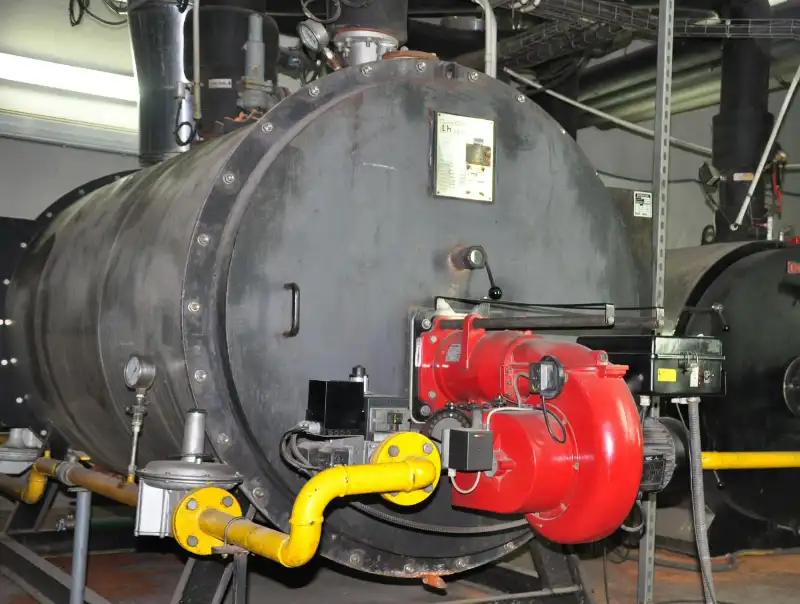
- Natural gas: thermal kWh cost = gas price / boiler efficiency. With a condensing boiler at 95%, the thermal kWh cost is approximately 5% above the gas price.
- Heat pump: thermal kWh cost = electricity price / COP. With a COP of 3.5 and grid electricity at EUR 0.15/kWh, the thermal kWh cost is EUR 0.043. With self-consumption at EUR 0.04/kWh, it drops to EUR 0.011/kWh.
In most current scenarios, the heat pump produces heat at a cost equal to or lower than gas. When combined with photovoltaic self-consumption, the savings are substantial.
Capital costs
The initial investment in an industrial heat pump is higher than that of an equivalent gas boiler. However, public subsidies (EU funds, national energy efficiency programmes, tax deductions) can cover 25% to 50% of the additional cost, and the typical payback period falls between 4 and 8 years.
Maintenance costs
Heat pumps have maintenance costs similar to or lower than those of gas boilers. They require no combustion inspection, produce no combustion residues and do not need a flue. Mandatory gas installation inspections (periodic inspections every 5 years in Spain) are no longer required.
Regulatory risk
The risk that natural gas will become more expensive through taxation (carbon taxes, removal of exemptions) is real and growing. Electrification eliminates this risk and positions the business on the right side of regulation.
Transition strategy: not everything at once
The transition from gas to electric does not have to be an overnight upheaval. A smart strategy consists of:
- Audit current consumption: identify what percentage of gas consumption goes to heating, DHW, thermal processes and other uses. Quantify each one.
- Prioritise the easiest uses to electrify: building heating and DHW production are the applications where the heat pump is most competitive. High-temperature processes are more complex and can be addressed in a second phase.
- Install photovoltaic self-consumption as soon as possible: solar PV has short payback periods and reduces electricity costs from day one.
- Replace equipment at the end of its useful life: instead of renewing a gas boiler that has reached the end of its service life, replace it with a heat pump.
- Consider hybrid solutions: a hybrid system with a heat pump as the primary unit and a gas boiler for peak demand can be the optimal solution during the transition period.
At Acoval Technical Installations we support industrial businesses in Valencia through the energy transition, working on heating and DHW, HVAC and electrical installations. We analyse each company’s real consumption profile, propose the most appropriate electrification strategy and execute the project with full technical guarantees. If you want to know your business’s savings potential, get in touch through our contact page.