Energy performance certification has been a legal requirement for the sale or rental of any building or premises in Spain since 2013, and similar obligations apply across the European Union under the Energy Performance of Buildings Directive (EPBD). Yet in the commercial and industrial sector, it remains one of the least understood and most poorly managed obligations. Many businesses simply obtain the minimum certificate needed to satisfy the formality, without considering that their building’s energy rating has direct implications for property value, operating costs and corporate image.
This article explains what energy performance certification is, when it is mandatory, what it evaluates and, most importantly, how to improve the rating of an existing commercial building.
What is an energy performance certificate?
An energy performance certificate (EPC) is an official document that rates a building or premises according to its energy consumption and CO2 emissions, assigning a letter from A (most efficient) to G (least efficient). It is the building equivalent of the energy label found on household appliances.
In Spain, the certificate is produced using approved software (CE3X, CERMA or other authorised tools) that analyses the building’s construction characteristics, thermal systems, lighting and other factors to calculate estimated energy consumption under standard usage conditions. Similar methodologies exist in every EU member state.
The result includes:
- An overall rating (A to G) for non-renewable primary energy consumption.
- A rating for CO2 emissions.
- An annex with improvement recommendations and their estimated impact on the rating.
When is it mandatory?
Spain’s Royal Decree 390/2021, updating previous regulations, establishes that an energy performance certificate is mandatory in the following cases:
- Sale or rental of any building or part of a building (premises, office, warehouse).
- New-build: the certificate must be obtained before the first occupation licence is granted.
- Public-use buildings with a usable floor area exceeding 250 m2 that are regularly visited by the public: the certificate must be displayed in a visible location.
- Buildings receiving public subsidies for energy efficiency improvements.
A notable addition in the 2021 regulation is the requirement for the certificate to include, where technically and economically viable, an assessment of the feasibility of installing renewable energy self-consumption systems.
Exemptions
Exempt categories include non-residential industrial and agricultural buildings in the areas used for workshops, industrial processes or agricultural activities (but not the office or public-facing areas of those buildings), places of worship, and officially protected buildings where improvements would unacceptably alter their character.
What does the certificate evaluate?
Thermal envelope
The certificate analyses the construction characteristics that determine a building’s heat losses and gains:
- Walls and facades: material, thickness, insulation.
- Roof: type, insulation, colour and reflectance.
- Floors: ground contact, insulation.
- Windows and glazing: glass type, frame material, solar factor, air tightness.
- Thermal bridges: junctions between building elements where additional heat losses occur.
Thermal systems
Heating, cooling, ventilation and domestic hot water systems typically account for the largest share of energy consumption in a commercial building:
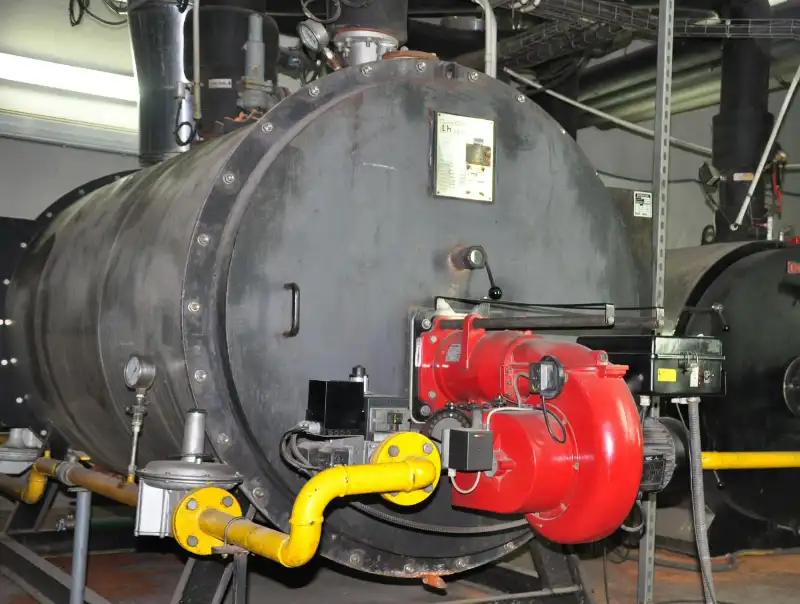
- Generator type: boiler, heat pump, electric resistance.
- Nominal and seasonal efficiency: the real-world efficiency of the equipment over the course of a year.
- Distribution system: pipework losses, circulation pumps, balancing.
- Emitter system: radiators, fan coils, underfloor heating, ductwork.
- Controls: thermostats, time programming, zoning.
Lighting
In commercial and office buildings, lighting can represent 20% to 40% of total electricity consumption. The certificate evaluates:
- Installed power per square metre.
- Luminaire types and light sources.
- Control systems (occupancy sensors, daylight-linked dimming).
Renewable energy
The contribution of renewable sources (photovoltaic, solar thermal, biomass) significantly improves the building’s rating, both for non-renewable primary energy consumption and for emissions.
How to improve the energy rating
Envelope improvements
- Roof insulation: typically the measure with the highest return in commercial buildings. Inadequate roof insulation can account for 30-40% of total heat losses.
- Window and door replacement: single glazing or frames without a thermal break are among the most common weak points.
- Facade insulation: external (ETICS/EIFS) or internal, depending on the building’s constraints.
System upgrades
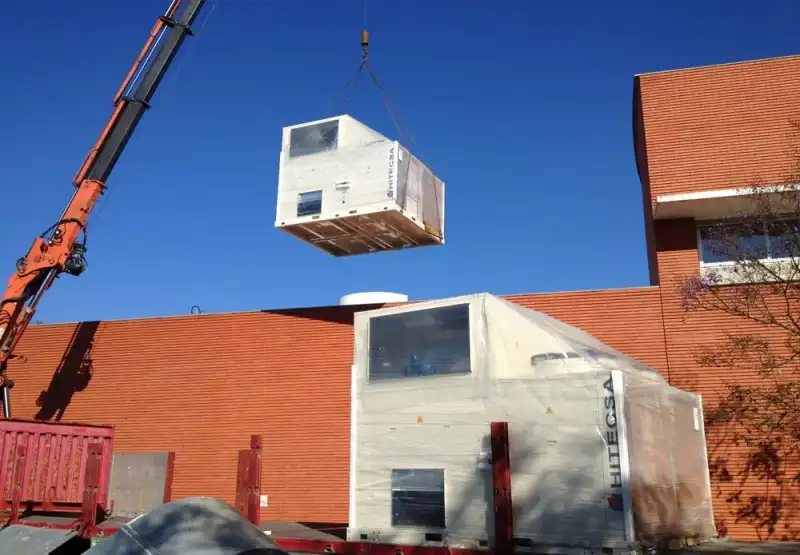
- Replacing old boilers with a heat pump: switching from a diesel or gas boiler operating at 85% efficiency to a heat pump with a COP of 3.5 can cut primary energy consumption by more than half.
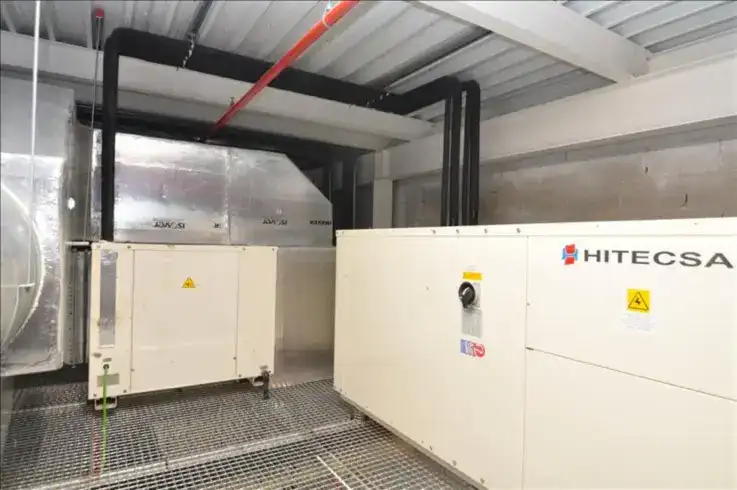
- HVAC equipment renewal: systems over 15 years old have significantly lower efficiency than current models.
- LED lighting: replacing conventional fluorescent tubes with LED can reduce lighting consumption by 50% to 70%.
- Installing heat recovery ventilation in mechanical ventilation systems.
Renewable energy integration
- Solar photovoltaic self-consumption: installing solar panels on the building’s roof directly improves the rating by reducing non-renewable primary energy consumption.
- Solar thermal: for domestic hot water production, supplementing or replacing conventional systems.
Controls and energy management
- Programmable zone thermostats.
- Occupancy sensors for lighting.
- Building Management Systems (BMS) that optimise the overall operation of building services.
The cost of inaction
A commercial building with a G rating does not merely consume more energy and emit more CO2 — it has a lower market value, is less attractive to tenants and buyers, and is more exposed to future regulatory tightening. The European Energy Performance of Buildings Directive (EPBD) is moving towards mandatory minimum performance standards for commercial buildings in the coming years, which will progressively devalue the least efficient properties.
Investing in the energy efficiency of a commercial building goes beyond regulatory compliance: it is an economic decision that reduces operating costs, improves occupant comfort and protects the value of the property asset over the medium and long term.
At Acoval Technical Installations we work to improve the energy efficiency of commercial and industrial buildings in Valencia, acting on HVAC, heating and electrical installations. If you want to know your building’s current rating and which measures could improve it, get in touch through our contact page.