A contaminated refrigeration circuit does not fail all at once. It degrades slowly, silently, until operating pressures spike, performance drops, the compressor begins to fatigue and the installation ends up requiring a major repair that would have been perfectly preventable.
Contamination in refrigeration circuits is one of the most frequent causes of costly breakdowns and premature reduction in equipment service life. Understanding what causes it, how to detect it and how to treat it is an essential part of the technical maintenance of any industrial or commercial refrigeration installation.
Types of contamination in refrigeration circuits
There is not a single type of contaminant. In practice, circuits often present several simultaneously, and the treatment varies depending on the agent involved.
Moisture
Water is the most frequent and one of the most dangerous contaminants. It enters the circuit during poorly executed repairs, through leaks in heat exchangers or via saturated desiccant filters that no longer retain moisture.
Once inside the system, water reacts with the refrigerant and lubricating oils at operating temperatures and pressures. The result is the formation of acids that attack the circuit’s metals, damage the varnish on the compressor’s motor windings and accelerate oil degradation. In systems operating below 0 C, moisture can freeze in the expansion valve and block refrigerant flow.
Degraded oil and acids
The compressor’s lubricating oil inevitably circulates through the refrigeration circuit. Over time, especially in the presence of moisture or elevated temperatures, the oil degrades: it loses viscosity, oxidises and generates residues that deposit on heat exchanger walls, piping and regulation components.
Degraded oil is both a cause and a symptom: it worsens compressor lubrication, reduces heat transfer in heat exchangers and obstructs valves and filters. System acidity — measurable using an analysis kit — is a direct indicator of the oil’s condition and the degree of contamination.
Solid particles
Solid particles in the circuit have various origins: metal shavings left behind during installation, rust generated by internal corrosion of copper or steel pipes, remains of defective solder joints or fragments from the compressor itself as it begins to wear.
These particles circulate with the refrigerant and act as an abrasive on circuit components. They can block expansion valves, damage compressor bearings and clog filter driers. In circuits that have suffered a compressor failure, the presence of metallic particles is virtually guaranteed and requires a complete cleaning before installing any new component.
Non-condensable gases
Non-condensable gases — mainly nitrogen or air — enter the circuit when working with low-pressure refrigerants or when maintenance is carried out without proper prior evacuation. These gases accumulate in the condenser, occupying space that should be reserved for the refrigerant and artificially raising condensing pressure.
The result is higher energy consumption, reduced refrigeration capacity and an increase in compressor discharge temperature that accelerates its ageing.
Symptoms that reveal a contaminated circuit
Contamination problems rarely manifest abruptly. They appear gradually, and many technicians confuse them with simple performance losses from other causes. The most common symptoms are:
- High condensing pressure without obvious climatic justification: this may indicate non-condensable gases or heat exchangers fouled by degraded oil deposits.
- Elevated compressor discharge temperature: a sign that the compression ratio has increased or that the compressor is operating under poor lubrication conditions.
- Reduced refrigeration output: the installation fails to reach target temperatures or takes longer than usual.
- Unusual compressor noise: knocking, excessive vibration or difficult starts may indicate particles in the oil or deteriorated lubrication.
- Frequent trips on high pressure or temperature: the protection system activates more frequently than normal.
- Detectable acidity in oil analysis: the colour change of the acidity indicator in the liquid sight glass or an analysis kit confirms the presence of acid contamination.
- Clogged filter drier: colour change in the liquid sight glass or excessive pressure drop across the filter indicates saturation.
Diagnosis: measure before acting
Before undertaking any cleaning process, it is essential to characterise the type and degree of contamination. The most widely used diagnostic methods are:
- Oil analysis: measures the acid number, the presence of metallic particles, viscosity and water content. It provides the most complete picture of the circuit’s condition.
- Pressure and temperature measurement at reference points: allows calculation of superheat, subcooling and the actual compression ratio versus the theoretical value.
- Sight glass inspection: the colour of the moisture indicator and the presence of bubbles offer quick information about the system’s condition.
- Heat exchanger thermography: detects areas of low heat transfer caused by internal deposits or oil plugs.
Circuit cleaning procedures
The cleaning procedure varies depending on the type of contaminant and the extent of damage. In general terms, the process includes the following phases:
1. Refrigerant recovery
The first step is always the complete recovery of the refrigerant using an approved recovery machine, in accordance with EU Regulation 517/2014 on fluorinated gases. Releasing the refrigerant into the atmosphere is not permitted.
2. Oil extraction and analysis
The oil is extracted from the compressor and, where possible, sent for analysis. The information obtained determines the most appropriate cleaning protocol.
3. Circuit flush
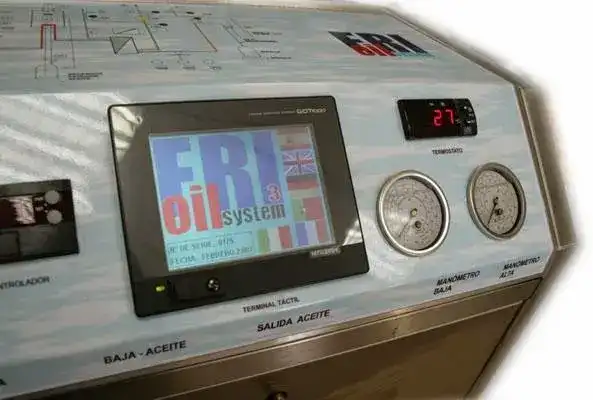
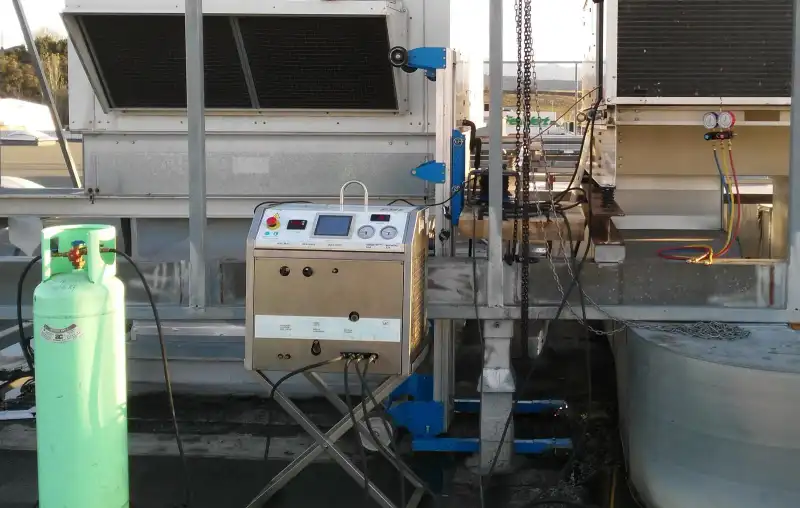
In circuits contaminated with degraded oil, particles or acids, a flush is performed using a cleaning agent specifically designed for refrigeration systems. This agent is introduced into the circuit, circulated for a set period and carries the contaminants away, which are removed together with the agent during the extraction phase.
Flush agents must be compatible with the circuit materials and must not leave residues that could contaminate the new oil or refrigerant.
4. Deep vacuum
After cleaning, a deep vacuum is drawn — below 500 microns — to remove all residual moisture. This phase is critical and should not be shortened to save time.
5. Replacement of consumable components
The filter drier is replaced, along with the expansion valve if there are signs of damage, and the compressor oil. If the compressor has suffered mechanical damage, its condition must be assessed before proceeding.
6. Refrigerant charge and supervised commissioning
The circuit is recharged with new refrigerant in the quantity specified by the manufacturer and a supervised start-up is carried out, measuring pressures, temperatures and consumption to verify correct operation.
Prevention: the best strategy
Most cases of contamination are preventable with good installation and maintenance practices:
- Always work with clean, dry connections during circuit interventions.
- Carry out correct evacuation before charging any system.
- Replace the filter drier every time the circuit is opened.
- Analyse the oil periodically in critical or high-workload installations.
- Do not over-extend maintenance intervals on equipment in continuous operation.
At Acoval we have the equipment and experience needed to diagnose and clean contaminated refrigeration circuits in all types of installations: industrial refrigeration, commercial HVAC, wine cellars and food cold chains in Valencia and the surrounding area.
If your installation is showing signs of contamination or if you have had a compressor failure and need to assess the circuit’s condition before proceeding, contact us. We act quickly and with technical rigour to get your installation back to optimal operating condition.